
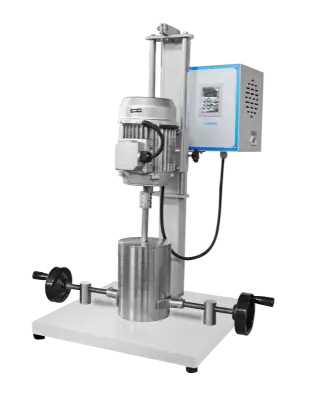
Description
Laboratory Stirred Ball Mill
Product Introduction
Stirred mills are mainly composed of a stationary grinding cylinder filled with small-diameter grinding media, a stirring device, and other auxiliary devices (such as circulation units, cooling units, timing and speed control systems, etc.). They feature high grinding efficiency and fine grinding particle size, which can well meet various process parameter requirements and simulate various indicators in actual production. Meanwhile, with the advantages of small-batch processing, low power consumption and cost-effectiveness, they are ideal equipment for universities, research institutes and enterprises to conduct research on grinding processes, new materials and coatings.
They are widely applied in the production of various fine powder materials in fields including zirconium silicate, zirconia, alumina, ceramics, chemical industry, electronic materials, magnetic materials, papermaking, coatings, non-metallic minerals, new materials, paints, graphite, calcium carbonate, pharmaceuticals and more.
Product Features
- High energy utilization rate and high power density, enabling outstanding energy-saving performance.
- Easy adjustment of product particle size; the fineness can be controlled by adjusting the residence time of materials in the cylinder.
- Low vibration and low noise during operation.
- Elegant and high-end appearance, reliable performance, simple maintenance, easy and labor-saving operation, and long service life.
- The stirring rod supports automatic lifting, and the grinding cylinder can be tilted freely.
- Capable of satisfying diverse process requirements, supporting continuous or batch production as needed.
- The grinding cylinder is designed with a jacket, allowing precise control of the grinding temperature.
- Customizable with various special functions, such as timing, speed regulation, circulation and temperature adjustment.
- Optional grinding cylinders and stirring components made of different materials (stainless steel, corundum ceramic, polyurethane, zirconia, etc.).
Technical Parameters
| Name | Speed (rpm) | Volume (L) | Loading Capacity (L) | Motor Power (kW) | Wear-Resistant Materials | Feed Particle Size (mm) | Discharge Particle Size (μm) | Speed Regulation Mode | Remarks |
| JM-1L | 50~1400 | 1 | 0.35 | 0.37 | Stainless steel, nylon, corundum, polyurethane, zirconia, agate, PTFE, etc. | ≤5 | ≤1 | Frequency conversion speed regulation | Laboratory Stirred Mill |
| JM-2L | 50~1400 | 2 | 0.7 | 0.37 | — | — | — | — | — |
| JM-3L | 50~1400 | 3 | 1.05 | 0.37 | — | — | — | — | — |
| JM-5L | 60~560 | 5 | 1.75 | 0.75 | — | ≤10 | — | Frequency conversion / fixed speed | Small Stirred Mill |
| JM-10L | 60~560 | 10 | 3.5 | 1.5 | — | — | — | — | — |
| JM-15L | 60~380 | 15 | 5.25 | 2.2 | — | — | — | — | — |
| JM-20L | 60~380 | 20 | 7.0 | 2.2 | — | — | — | — | Light-duty Stirred Mill |
| JM-30L | 60~310 | 30 | 10.5 | 3 | Carbon steel, stainless steel, lined with nylon, polyurethane, PTFE, corundum, etc. | — | — | — | — |
| JM-50L | 60~140 | 50 | 17.5 | 4 | — | ≤15 | — | — | Production Stirred Mill |
| JM-100L | 60~140 | 100 | 35 | 7.5 | — | — | — | — | — |
| JM-200L | 60~110 | 200 | 70 | 11 | — | — | — | — | — |
| JM-300L | 60~110 | 300 | 100 | 15 | — | — | — | — | — |
| JM-500L | 60~90 | 500 | 170 | 18.5 | — | — | — | — | — |
| JM-600L | 60~90 | 600 | 200 | 22 | — | — | — | — | — |
Working Principle
The main shaft drives the stirrer to rotate at a high speed, making the grinding media move irregularly. This chaotic motion generates collision, extrusion, friction and shearing forces between the grinding media, thus pulverizing and fine-grinding the materials.
In addition, different sizes, shapes and ratios of grinding media will lead to different grinding effects. Generally speaking, larger grinding media result in coarser particle size of the ground materials, while smaller media produce finer powder. A proper ratio of grinding media with different specifications, combined with appropriate speed adjustment, will achieve better grinding performance.
