
🌐 Foreword: The Promise and Peril of Ultra-High Nickel Cathodes
Ultra-high nickel layered cathodes (such as Ni90) are the cornerstones of next-generation high-energy-density lithium-ion batteries due to their exceptional specific capacity. However, in practical applications, Ni90 faces significant hurdles: lattice structural instability, severe electrolyte oxidation at high voltages, and sluggish lithium-ion diffusion kinetics.
How can we extract maximum specific energy while ensuring the long-term “peace and stability” of the cell? This issue presents an industrial-grade evaluation of the Ni90 || Graphite (Gr) system, demonstrating how customized interfacial engineering resolves the stability challenges inherent in high-nickel chemistries.
📊 Empirical Data: Industrial-Grade Performance with “Near-Zero Decay”
This evaluation utilized 1.2 Ah pouch full cells within a 4.3V high-voltage window, yielding compelling results:
1. Massive Energy Release
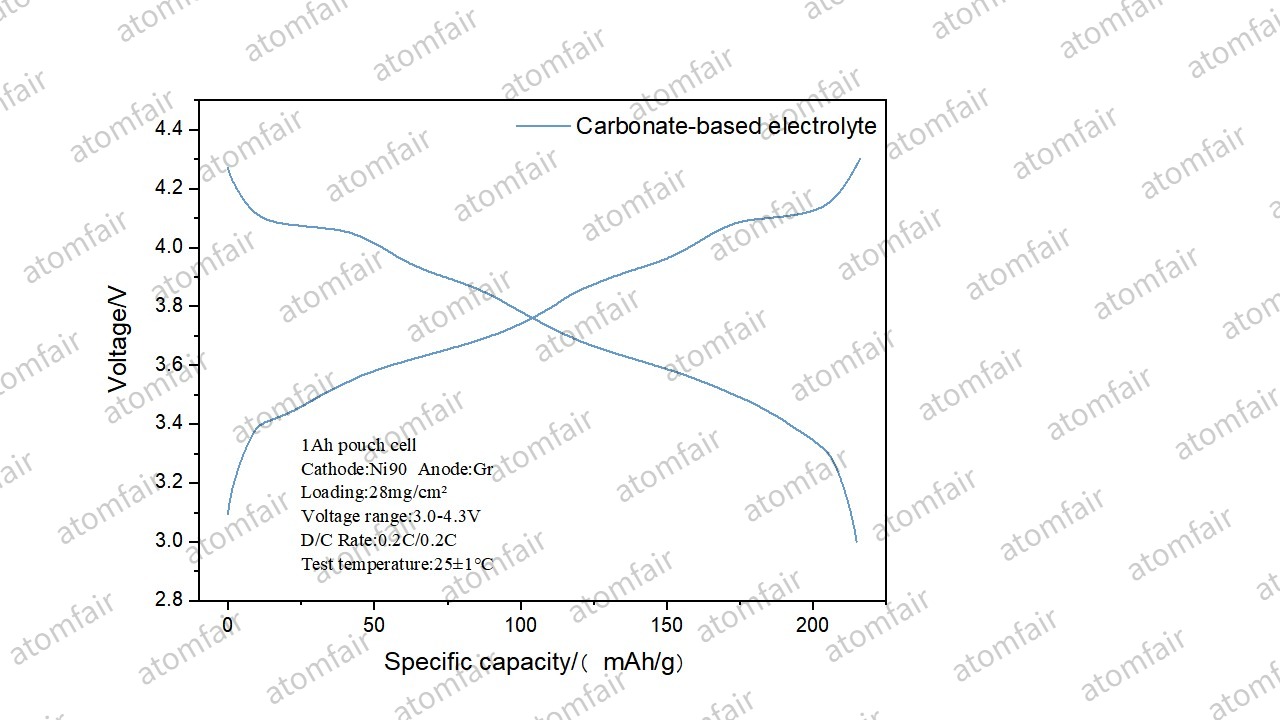
- Specific Capacity: Measured at an impressive 214.92 mAh/g.
- Curve Insight: The Galvanostatic Charge-Discharge (GCD) curves reveal that the single-crystal-like Ni90 cathode provides a remarkably high discharge plateau. Even under a high areal mass loading of 28 mg/cm², the curves remain smooth with minimal polarization, indicating superior rate capability.
2. Near-Horizontal Cycling Profile
The most striking data appears in the cycling graph:
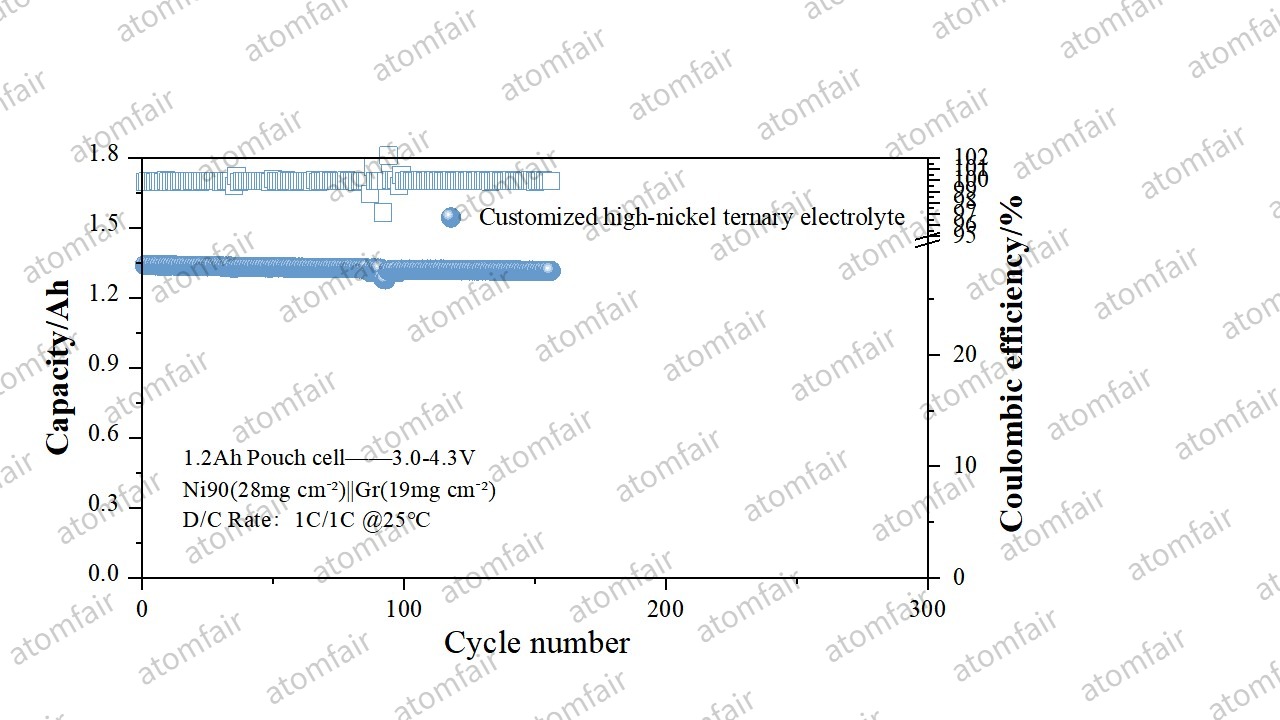
- Cycle Life: Paired with a Customized High-nickel Electrolyte, the cell maintained a retention rate of 98.10% after 161 cycles.
- Insights: The near-horizontal trend of the cycling curve indicates an extremely stable operational state. This confirms that the combination of high-stability Ni90 and specialized electrolytes effectively suppresses micro-crack growth and gas evolution. It overcomes the chronic issue of particle pulverization caused by anisotropic volume changes in ultra-high nickel materials and establishes a dynamic barrier against transition metal dissolution and continuous electrolyte oxidation.
💡 Deep Insight: How Customized Electrolytes “Fortify and Repair”
In high-nickel systems, the electrolyte serves not only as an ion transporter but also as an interfacial “repair technician”:
- Construction of Anti-Oxidative CEI: For the highly oxidative 4.3V environment, our customized electrolyte induces the formation of an ultra-thin, dense, and highly conductive Cathode Electrolyte Interphase (CEI). This film isolates high-activity sites from the electrolyte, curbing gas evolution at the source.
- Kinetic Optimization: By precisely regulating the primary solvation sheath of lithium ions, we successfully lowered the energy barrier of the interfacial desolvation process. This accelerates ion transport kinetics at the electrode/electrolyte interface and suppresses side reactions induced by concentration polarization. Consequently, the accumulation of the resistive rock-salt phase on the Ni90 surface is delayed, resolving the common pain point of kinetic fading caused by surging charge-transfer impedance.
- Full Lifecycle Stability: Matched with high-loading graphite anodes (19 mg/cm²), the SEI and CEI layers achieve a perfect equilibrium, ensuring structural consistency under 1C charge/discharge conditions.
🛠️ Technical Specifications of the Evaluation System
- Cathode: High-Stability Ni90 Layered Cathode (28 mg/cm²)
- Anode: High-Performance Artificial Graphite (19 mg/cm²)
- Cell Format: 1.2 Ah Pouch Cell
- Cut-off Voltage: 3.0V – 4.3V
- Performance Benchmark: 98.10% Retention at 161 Cycles