
NFPP System: The Foundation of 10,000-Cycle Performance
🌐 Foreword: The Second Half of Energy Storage—Who is the “Longevity King”?
As the industrialization of sodium-ion batteries (SIBs) accelerates, the energy storage market has imposed nearly stringent requirements on battery performance. Among the various material systems, Sodium Iron Pyrophosphate (NFPP), a polyanionic compound, is widely recognized as the “marathon runner” of the SIB world due to its robust 3D network lattice structure.
However, empirical evidence shows that even with a structurally stable cathode, reaching the 10,000-cycle “ceiling” is impossible without deep synergy from high-performance electrolytes. In this issue, we decode how NFPP achieves extreme cycle life by comparing two high-performance electrolyte solutions.
📊 Measured Performance: The Leap from 5,000 to 7,000 Cycles
This evaluation utilized industrial-grade Ah-scale pouch full cells. By conducting stress tests on the NFPP-HC (Hard Carbon) system under different electrolyte environments, we demonstrated distinct degradation logics:
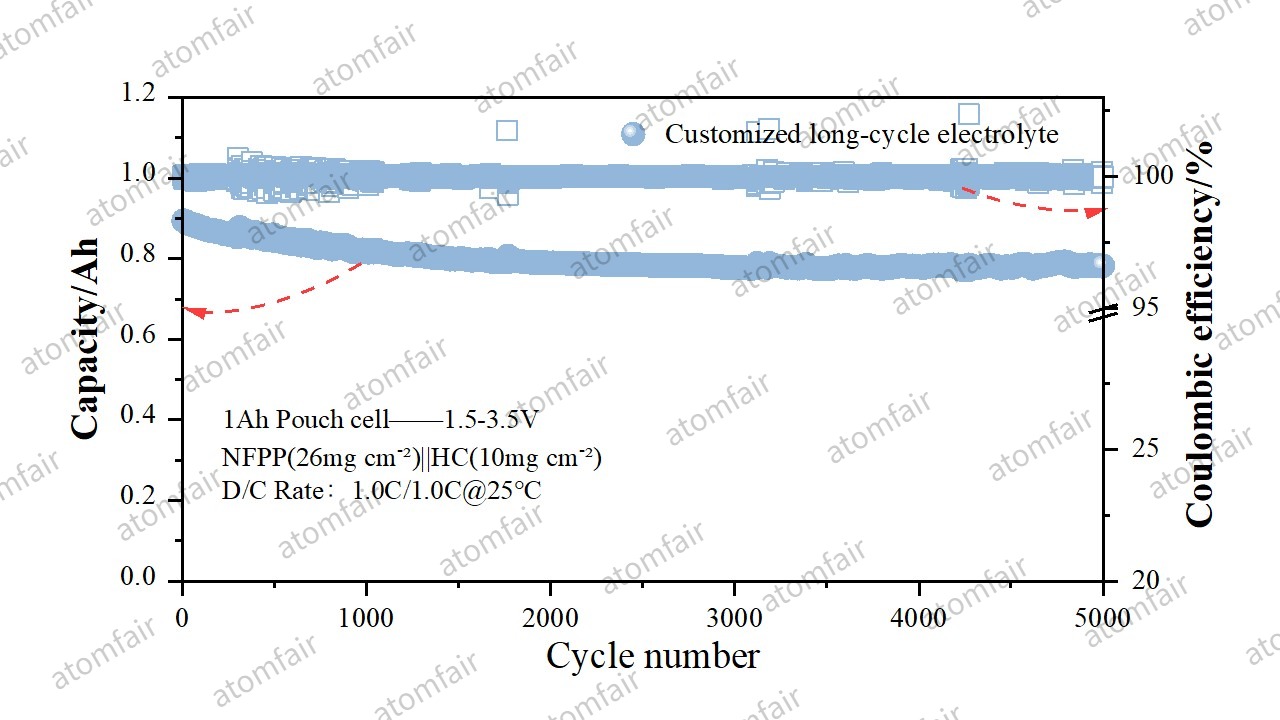
1. Solution A: High-Performance General System (5,000 Cycles @ 1C)
Within a 1.5V – 3.5V window using an Enhanced Electrolyte with standard additives, the cell maintained a capacity retention of 87.56% after 5,000 cycles at a 1C rate. This confirms that even under standard protection, the NFPP cathode exhibits cycling stability far superior to that of layered oxides.
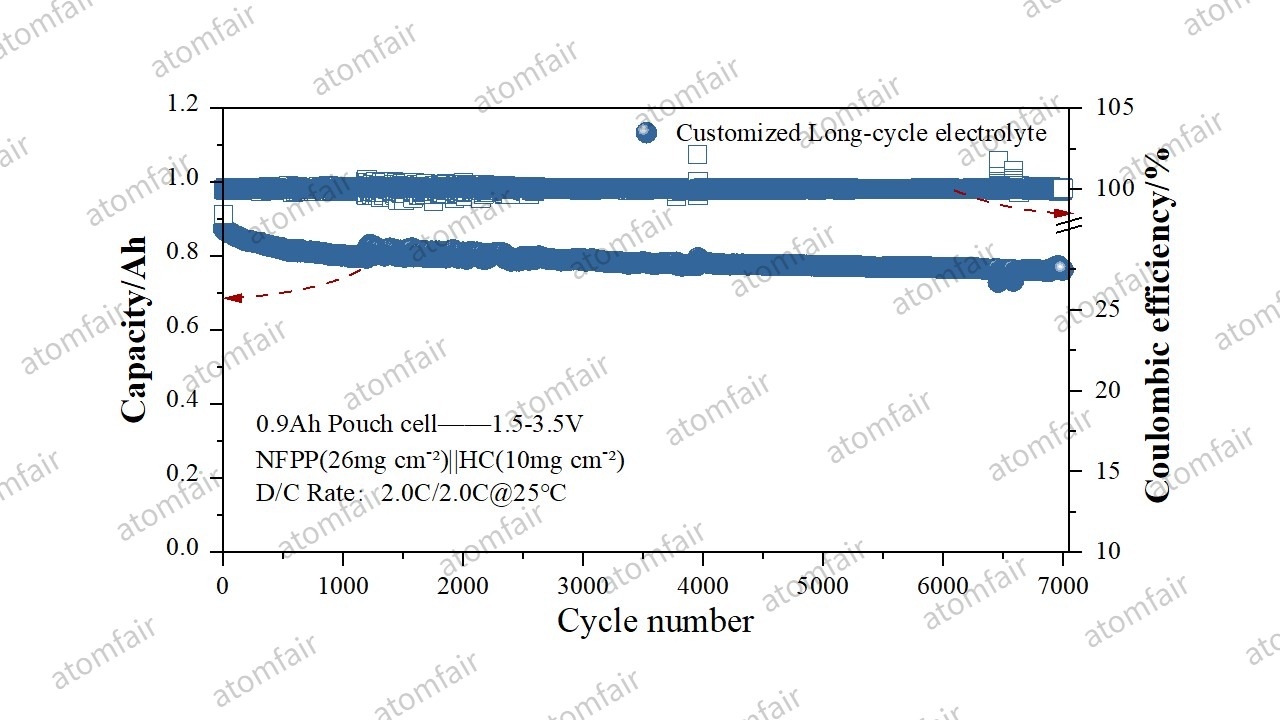
2. Solution B: Targeted Customized Long-Cycle System (7,000 Cycles @ 2C)
When switching to a Customized Long-cycle Electrolyte deeply optimized for the NFPP system, a qualitative leap in performance occurred. Even at a higher 2C charge/discharge rate, the capacity retention remained a solid 87.24% after 7,000 cycles.
- Coulombic Efficiency (CE): As shown in the data, the CE curve for Solution B almost perfectly aligns with the 100% line. This indicates that through a more precise additive ratio, we have effectively suppressed the trace consumption of active sodium ions during long-term cycling, pushing the system’s potential toward the 10,000-cycle milestone.
💡 Deep Insight: Why is the Electrolyte a “Performance Multiplier” for NFPP?
While NFPP materials possess “zero-strain” lattice characteristics, any minor fluctuation at the microscopic interface over thousands of cycles will evolve into macroscopic capacity decay due to the integration effect.
Compared to Solution A, the Customized Long-cycle Solution B implements higher-dimensional solvation structure regulation specifically for the 3.0V operating plateau of NFPP. It not only optimizes ionic conductivity to accommodate high 2C rates but, more importantly, induces the formation of an ultra-thin, dense, inorganic-dominated interface on the surface of the spherical NFPP particles. This film blocks continuous side reactions and locks in the material’s structural activity under high-rate environments, achieving true compatibility between high power and long life.
🛠️ Technical Specifications of the Evaluation System
- Cathode: High areal density NFPP electrode (26 mg/cm²)
- Anode: Compatible Hard Carbon electrode (10 mg/cm²)
- C-rate / Temperature: 2.0C / 2.0C @ 25°C
- Performance Benchmark: >87% retention at 7,000 cycles
- Fundamentals, status and promise of sodium-based batteries
DOI: 10.1038/s41578-021-00324-w
High-level authoritative review of sodium-based battery chemistry, commercialization status, electrode materials, electrolyte requirements, and cycle-life limitations relevant to NFPP-hard carbon full cells. - Sodium-ion batteries: present and future
DOI: 10.1039/c6cs00776g
Comprehensive Chemical Society Reviews article covering sodium-ion cathodes, anodes, electrolytes, full-cell design, and performance metrics including capacity retention and coulombic efficiency. - Research Development on Sodium-Ion Batteries
DOI: 10.1021/cr500192f
Foundational Chemical Reviews paper on sodium-ion battery materials and electrochemistry, useful for contextualizing polyanionic cathodes, hard carbon, electrolyte effects, and long-cycle testing.