
🔍 Industry Trends: The “High-Energy” Second Half for 3C Batteries
In the fields of smartphones and high-end wearables, traditional graphite anodes (360 mAh/g) are increasingly struggling to meet the dual demands of ultra-thin profiles and extended battery life. The 560 mAh/g composite anode (approx. 15% silicon-carbon blended with graphite) is becoming the standard for next-generation flagship cells due to its perfect balance between energy density and processability.
However, when a 15% Si-C system is paired with 4.5V ultra-high voltage Lithium Cobalt Oxide (LCO), the system faces severe challenges: oxidative cobalt dissolution at the cathode and the loss of electrical contact in the anode due to the frequent volumetric expansion of silicon particles.
📊 Empirical Deconstruction: Robust Performance of the 560 Composite Anode System
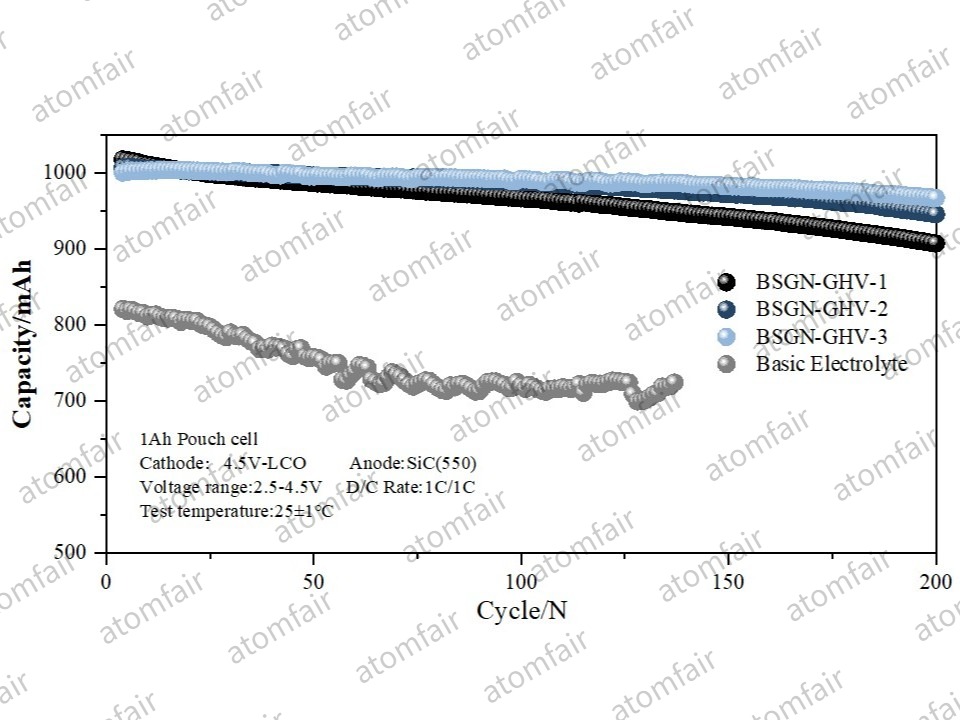
This evaluation utilized 1Ah industrial-grade pouch cells within a 2.5V – 4.5V range to verify the synergistic effects between this frontier system and customized electrolytes:
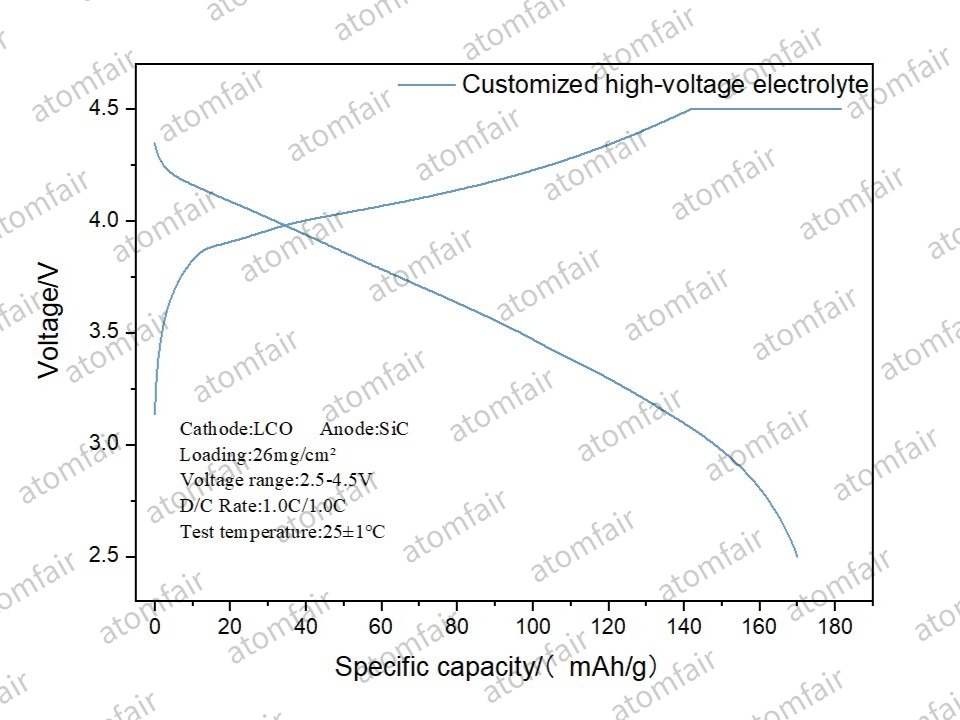
- ➡️ Specific Capacity and Specific Energy Empirical data shows that the high-voltage LCO cathode released a specific capacity of 169.98 mAh/g. When paired with the 560 mAh/g composite anode, the cell exhibited exceptional volumetric energy density, significantly improving space utilization for consumer electronics.
- ➡️ A Decisive Leap in Electrolyte Engineering The test compared multiple formulations. The cycling data clearly shows that cells using a Basic Electrolyte suffered significant capacity decay, whereas those using our AF-GHV Series Customized High-Voltage Electrolyte exhibited high resilience in their cycling curves.
- ➡️ Cycling Stability Metrics After 200 cycles, the capacity retention remained solid at 96.75%. Based on current decay rates and Coulombic Efficiency (CE), this solution is projected to easily exceed 1,000 stable cycles, effectively addressing the lifespan pain points typical of silicon-containing systems.
💡 Deep Insight: How AF-GHV Electrolytes Tame 15% Si-C Systems
The achievement of 96.75% retention stems from a “dual-directional regulation” strategy targeting both the 560 composite anode and the high-voltage LCO:
- Cathode Side: Constructing a High-Voltage “Isolation Zone” The AF-GHV series electrolyte introduces specialized anti-oxidative additives that induce the formation of a dense Cathode Electrolyte Interphase (CEI) on the LCO surface. This layer effectively prevents solvent oxidation and transition metal dissolution under high-voltage stress.
- Anode Side: Constructing an “Elastic” Conductive Network To address the volumetric effects of 15% silicon-carbon doping, the electrolyte formulation optimizes film-forming components to create a high-modulus Solid Electrolyte Interphase (SEI). This film maintains excellent electrical contact with the graphite substrate even during the frequent contraction of silicon particles, suppressing active lithium loss caused by “interfacial collapse.”
- A Victory of Systems Engineering This approach, rooted in fundamental chemical logic, allows the 560 composite anode to maintain high capacity while achieving cycling stability comparable to pure graphite systems.
🛠️ Technical Specifications Benchmarking
- ➡️ Electrode System: High-Voltage LCO paired with 560 mAh/g Composite Anode (15% SiC + Gr)
- ➡️ Cut-off Voltage: 2.5V – 4.5V
- ➡️ Measured Specific Capacity: 169.98 mAh/g
- ➡️ Cycling Performance: 96.75% @ 200 Cycles (Projected > 1,000 Cycles)
- ➡️ Core Driver: AF-GHV Series Customized High-Voltage Electrolyte
🔬 Advanced R&D Roadmap for Laboratories
If you are dedicated to conquering next-generation high-range, ultra-thin 3C cell projects:
- System Benchmarking: We recommend using the 560 Si-C composite anode as your experimental baseline to evaluate the true electrochemical limits of materials at 4.5V.
- Targeted Electrolyte Optimization: The AF-GHV Series offers multiple specialized formulations. We invite you to consult us for the 560-Grade Composite Anode Electrolyte Proposal and the corresponding 1Ah Industrial Pouch Cell Empirical Parameter Manual.
- A reflection on lithium-ion battery cathode chemistry
DOI: 10.1038/s41467-020-15355-0
High-level review of lithium-ion cathode chemistry, layered oxide behavior, voltage limits, and cathode degradation issues relevant to high-voltage LCO operation. - Li-ion battery materials: present and future
DOI: 10.1016/j.mattod.2014.10.040
Broad authoritative review covering graphite, silicon-based anodes, layered oxide cathodes including LCO, energy-density tradeoffs, and degradation mechanisms relevant to high-energy 3C cells. - Electrolytes and Interphases in Li-Ion Batteries and Beyond
DOI: 10.1021/cr500003w
Foundational review on electrolyte chemistry, SEI/CEI formation, interphase stability, and high-voltage limitations directly supporting the page's electrolyte-engineering discussion.