
Breaking Range Limits: Long-Cycle Life for Ni90 + 60% Si-C Systems
🌐 Foreword: The “Ultimate Battlefield” for High Energy Density
To eliminate range anxiety in electric vehicles (EVs), the competition for energy density has reached a fever pitch. The combination of Ni90 high-nickel cathodes and high-silicon carbon (SiC) anodes is widely regarded as the “golden duo” for achieving energy densities exceeding 300 Wh/kg.
However, the massive volumetric expansion of high-content silicon carbon during lithiation and delithiation cycles leads to the repeated rupture and regeneration of the Solid Electrolyte Interphase (SEI). This process results in the rapid depletion of the electrolyte, severely compromising cycle life. In this column, we will demonstrate how to “tame” systems with 60% silicon content through the targeted development of specialized electrolytes.
📊 Measured Performance: “Ultimate Range” Benchmarks for Pouch Cells
In this evaluation, 1.2 Ah soft-package (pouch) full cells were utilized to perform a deep-dive performance deconstruction of the Ni90 || 60% Si-C system:
1. Exceptional Specific Capacity Utilization
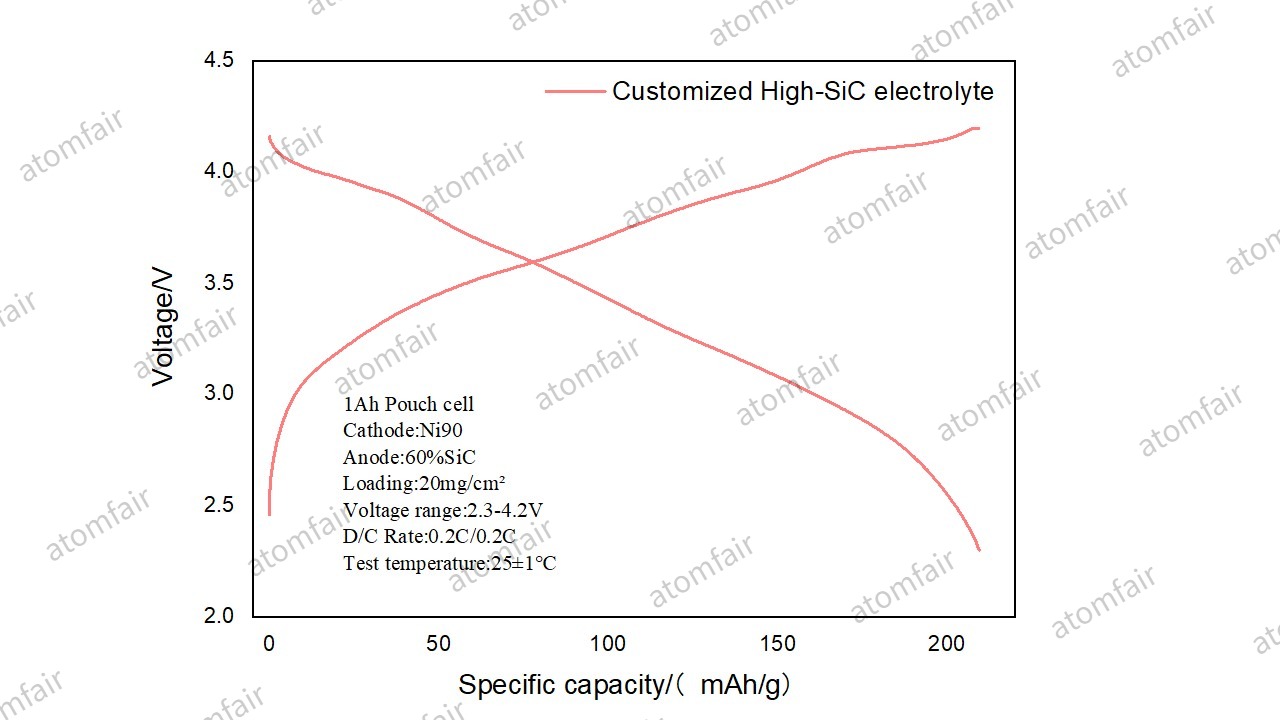
- Data Performance: Under an operating voltage window of 2.3–4.2V, the system achieved an ultra-high specific capacity of 209.5 mAh/g.
- Technical Insights: The Galvanostatic Charge-Discharge (GCD) curves demonstrate that the Ni90 cathode provides a remarkably high discharge plateau. When paired with the high gram-capacity of the 60% silicon-carbon (Si-C) anode, it delivers a massive energy output for the cell.
2. Paradigm-Shifting Cycle Stability
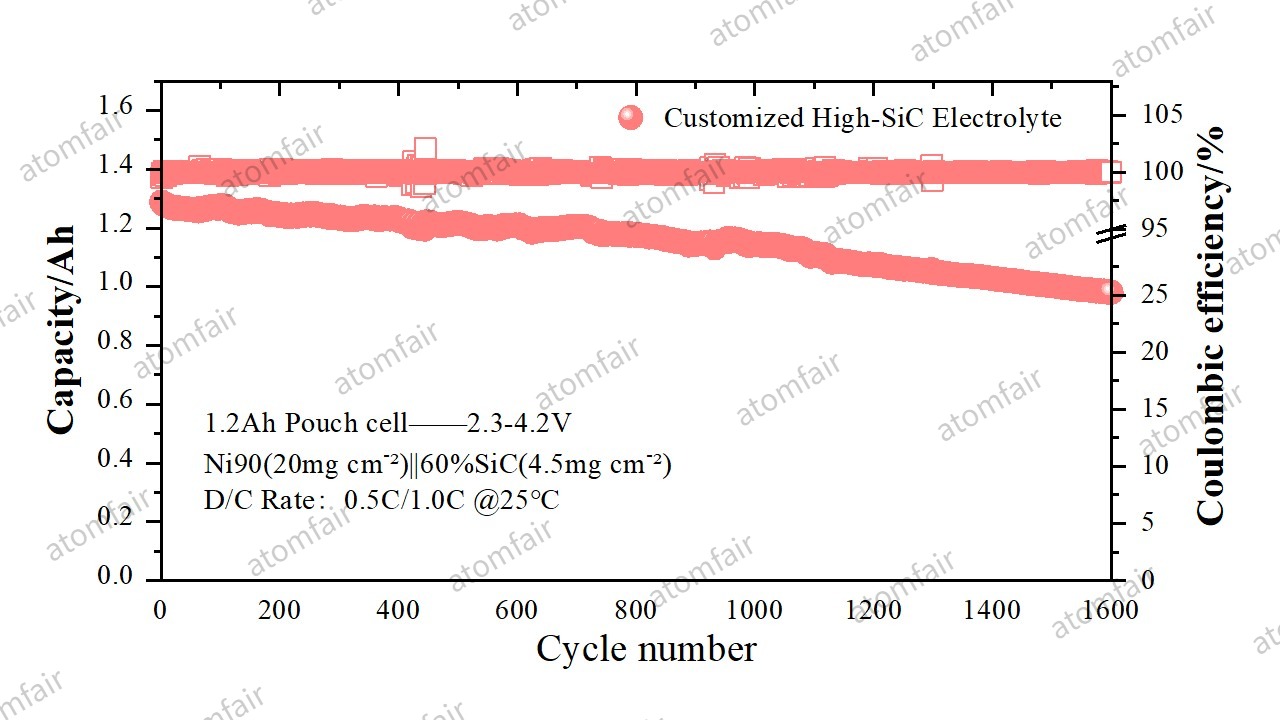
For systems with a silicon content as high as 60%, electrochemical failure typically occurs within a few hundred cycles due to massive lithium loss. However, the data reveals a significant breakthrough:
- Cycle Life: By utilizing a Customized High-SiC Electrolyte, the cell achieved over 1,600 stable cycles.
- Coulombic Efficiency (CE): The CE remained consistently above 99.9% throughout the testing period.
- Technical Breakdown: These results indicate that through advanced electrolyte engineering, we have successfully constructed a highly elastic SEI (Solid Electrolyte Interphase) on the surface of the active silicon. This nanolayer effectively buffers the interfacial stress induced by volumetric expansion, preventing mechanical degradation.
💡 Deep Insight: How Electrolytes Salvage “Expanding” Silicon-Carbon Anodes
- Toughening and Reconstruction of the SEI Layer: The customized high-SiC electrolyte introduces specialized film-forming monomers. The resulting Solid Electrolyte Interphase (SEI) is no longer a brittle accumulation of inorganic salts; instead, it possesses polymer-like flexibility. This allows the film to “breathe” in tandem with the expansion and contraction of silicon particles, significantly reducing the irreversible loss of active lithium.
- Balancing High Mass Loading: This evaluation employed a high-loading design, featuring a cathode at 20 mg/cm² and an anode at 4.5 mg/cm². Achieving 1,600 cycles under the extreme pressures of high compaction density and high areal capacity demonstrates the engineering maturity of this comprehensive material solution.
🛠️ Technical Specifications of the Evaluation System
Cathode: Ni90 High-Nickel Ternary (20 mg/cm²)
Anode: 60% Silicon-Carbon Anode (4.5 mg/cm²)
Electrolyte: Customized High-SiC Electrolyte
Cut-off Voltage: 2.3V – 4.2V
Performance Benchmark: 1.2 Ah Pouch Cell with 1,600+ stable cycles
🔬 Advanced R&D Roadmap for Laboratories
If your primary research focuses on high-energy-density power batteries:
- Start with “Material Matching”: The compatibility between Ni90 and 60% Si-C is extremely sensitive. We recommend referring to our Industrial-Grade N/P Ratio Design Guidelines to ensure balanced cell performance.
- Focus on the “Core Variable”: In high-silicon systems, the electrolyte is the critical factor for cell survival. Utilizing our Customized High-SiC Electrolyte Series as a benchmark can significantly accelerate your experimental R&D cycles and development timelines.
- A reflection on lithium-ion battery cathode chemistry
DOI: 10.1038/s41467-020-15355-0
Provides authoritative context on lithium-ion cathode chemistry evolution, energy-density drivers, and the role of nickel-rich layered oxides. - Alloy Negative Electrodes for Li-Ion Batteries
DOI: 10.1021/cr500207g
Foundational review of alloying anodes including silicon, covering lithiation mechanisms, volume change, capacity retention, and practical full-cell challenges. - Electrolytes and Interphases in Li-Ion Batteries and Beyond
DOI: 10.1021/cr500003w
Foundational review on electrolyte chemistry and interphase formation in lithium-ion batteries, relevant to claims about customized electrolytes, SEI stability, and coulombic efficiency.