
4.3V P2 Systems: Electrolytes vs. Phase Transition Plunges
🌐 Foreword: The “High-Voltage Temptation” and Challenges of P2-Type Materials
Within the cathode family of sodium-ion batteries (SIBs), P2-type layered oxides stand out for their unique open framework, offering superior rate performance and ion conduction rates compared to O3-type counterparts. However, the P2 system faces a formidable “red line” at 4.2V.
Once the charging voltage exceeds 4.2V, the P2 structure undergoes a severe P2-O2 phase transition, accompanied by transition metal migration. In empirical testing, this typically manifests as a sudden “plunge” in capacity and significant voltage decay. The critical question remains: how can we maintain systemic stability within the high-energy 4.3V range?
📊 Data Comparison: An “Endurance Race” Between Three Electrolytes
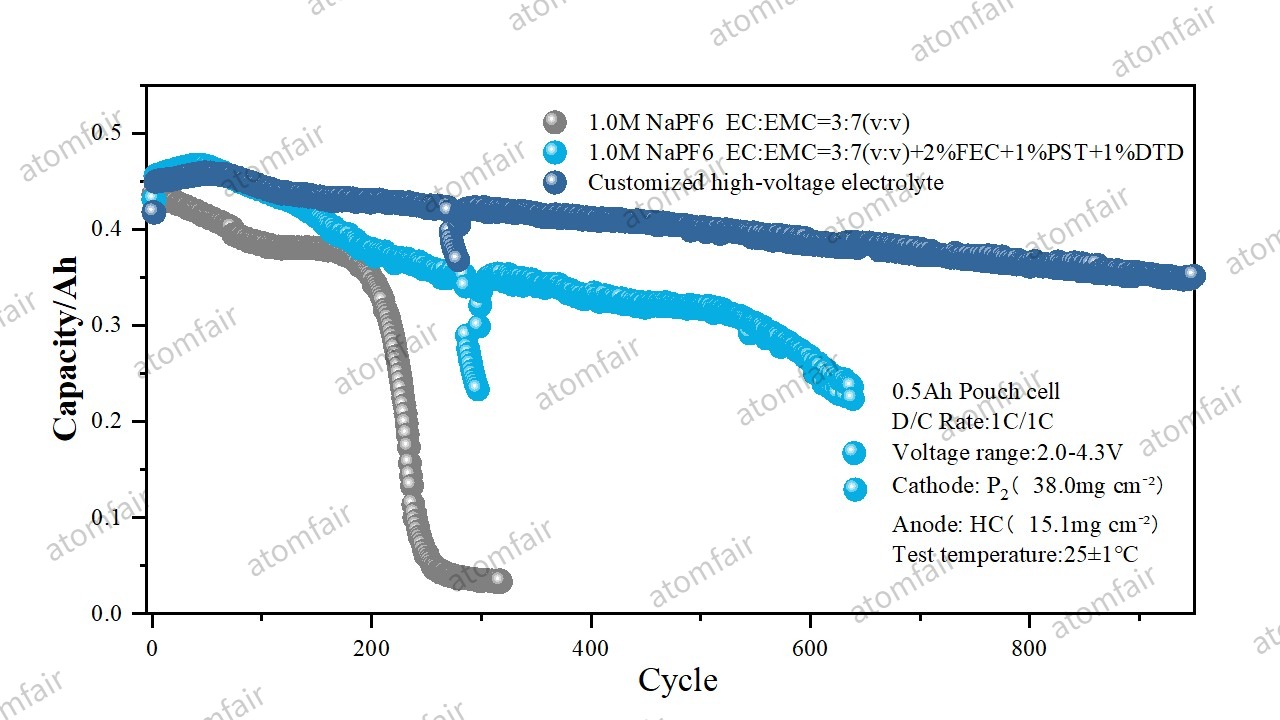
The figure illustrates a comparative evaluation of P2 || HC (Hard Carbon) pouch cells within a 2.0V – 4.3V window:
- Baseline Electrolyte (Grey): Capacity suffered a “cliff-like” collapse in fewer than 200 cycles. This is a classic failure mode caused by violent electrolyte oxidation and the structural collapse of the cathode at high voltages.
- Additive-Optimized Version (Light Blue): While it pushed the “plunge point” to approximately 600 cycles, it failed to fundamentally resolve the interfacial instability at 4.3V.
- Customized High-Voltage Electrolyte (Red): Demonstrated exceptionally robust performance, maintaining a capacity retention of over 80% after 950 cycles.
💡 Deep Insight: From “Interfacial Protection” to “Phase Transition Inhibition”
How does this customized electrolyte revitalize the P2 system? By analyzing the interfacial construction at the 4.3V ultra-high voltage limit, we found:
- Suppression of Transition Metal Dissolution: The high-voltage customized components form a dense protective layer on the P2 cathode surface. This effectively blocks the dissolution and “shuttling” of transition metals like Manganese (Mn).
- Mitigation of P2-O2 Evolution: A stable interface does more than just protect the electrolyte; at the microscale, it relieves structural stress on the material surface, thereby delaying the irreversible phase transitions that trigger capacity drops.
- A Triumph of Pouch Cell Engineering: The evaluation utilized an ultra-high mass loading of 38.0 mg/cm², proving that this P2 || HC system solution possesses immense potential for high energy density applications.
🛠️ Technical Specifications of the Evaluation System
- Cathode: P2-Type Layered Oxide (38.0 mg/cm²)
- Anode: Hard Carbon (15.1 mg/cm²)
- Voltage Window: 2.0V – 4.3V (Ultra-High Cut-off Voltage)
- Measured Data: >80% Retention at 850 Cycles
- Sodium-ion batteries: present and future
DOI: 10.1039/c6cs00776g
Authoritative review covering sodium-ion battery cathodes, anodes, electrolytes, and commercialization challenges; supports the broader technical context for P2 layered oxide and hard-carbon sodium-ion cells. - P2-type Nax[Fe1/2Mn1/2]O2 made from earth-abundant elements for rechargeable Na batteries
DOI: 10.1038/nmat3309
Foundational peer-reviewed work on P2-type layered sodium transition-metal oxide cathodes, directly supporting discussion of P2 materials, Mn-containing layered oxides, and sodium-ion cathode performance.