
Dry Electrodes: The Cure for “Crystal Water” in Prussian Blue?
🌐 Foreword: The Cost of Fame for Prussian Blue
Prussian Blue (PB) cathode materials have long been considered the “ideal choice” for sodium-ion batteries due to their wide ionic channels, ultra-high theoretical specific capacity, and low raw material costs. However, the nearly ineradicable interstitial crystal water within its lattice acts like a “time bomb.” During cycling, this water induces electrolyte decomposition, leading to severe gas evolution (swelling) and structural collapse.
The challenge remains: how can crystal water be removed cost-effectively and efficiently? Traditional slurry-based (wet) coating processes often lead to binder failure during high-temperature baking. In this column, we present a “hardcore” answer through Dry Electrode Technology.
🛠️ Process Breakthrough: The “Dehydration” Superpowers of Dry Processing
The data presented is based on an evaluation of pouch cells using a Dry PB || Hard Carbon (HC) system.
- Core Logic: Dry electrode technology eliminates the use of solvents. The PTFE binder employed possesses superior thermal stability, allowing the electrodes to undergo prolonged, ultra-high-temperature baking after fabrication. This enables the deep removal of lattice crystal water without compromising the structural integrity of the electrode.
- High-Loading Performance: The evaluation utilized a cathode mass loading of 27.35 mg/cm² and an anode loading of 7.5 mg/cm². Such industrial-grade high loading not only boosts energy density but also validates the structural stability of dry processing for thick electrodes.
📊 Empirical Data: The Miracle of 1,000 Cycles and Zero Outgassing
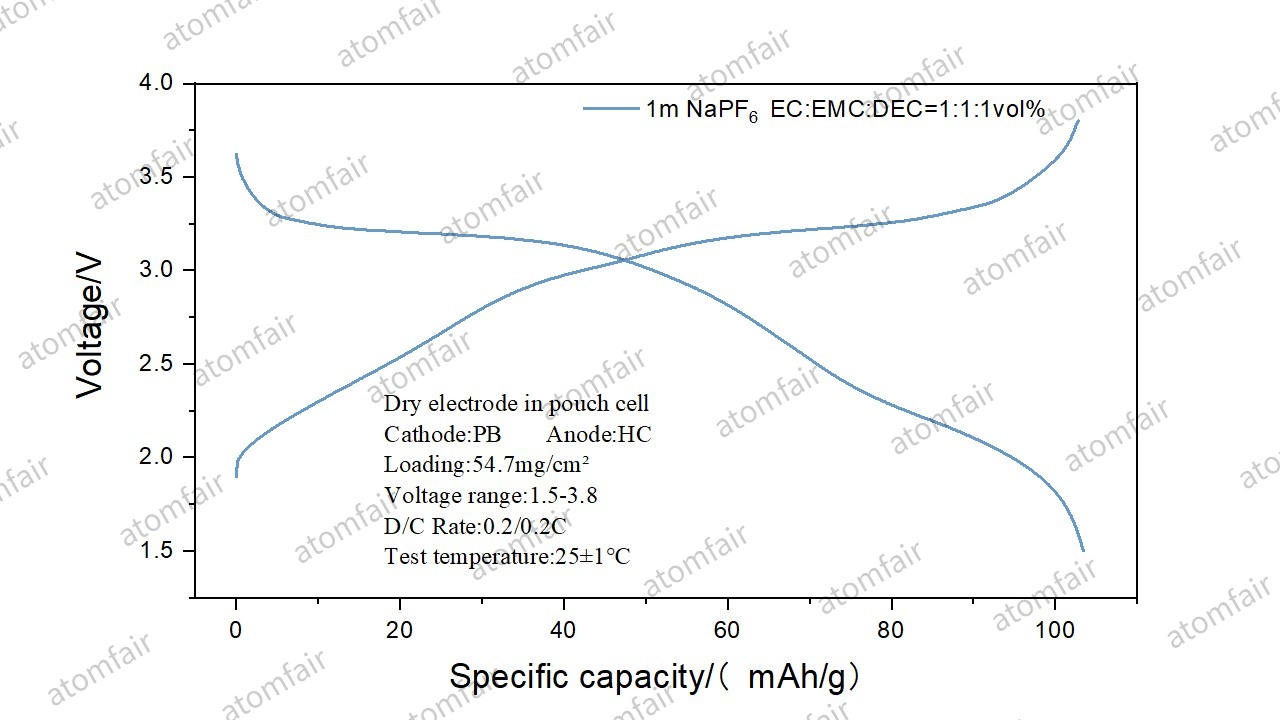
1. GCD Curves: Stable Voltage Plateaus
The Galvanostatic Charge-Discharge (GCD) curves within the 1.5V – 3.8V window demonstrate clear and stable plateaus. This indicates that the dry-processed cathode maintains the integrity of the Prussian Blue lattice, exhibiting excellent electrochemical kinetics.
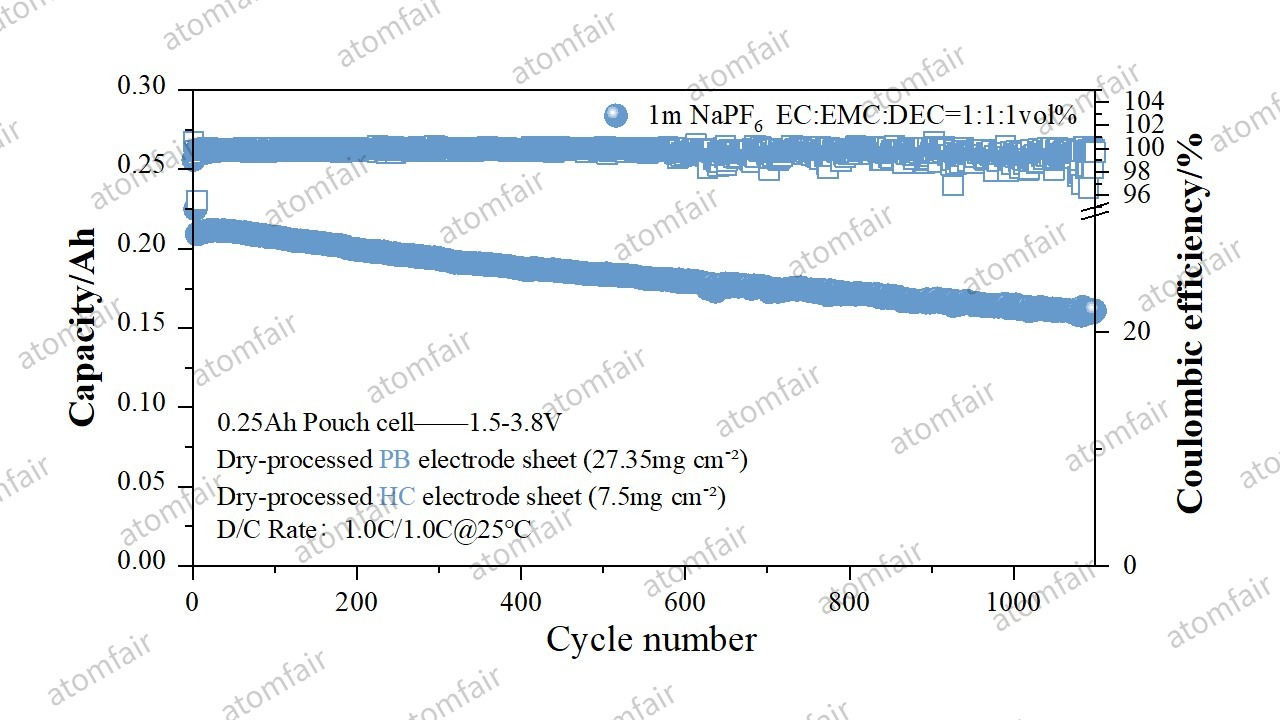
2. Cycling Performance: Breaking the 1,000-Cycle Barrier
The cycling data provides the most encouraging results:
- 80.25% Retention at 920 Cycles: Utilizing a standard carbonate-based electrolyte (rather than expensive specialty formulations), the PB system approached the 1,000-cycle milestone—a top-tier performance within the industry.
- Coulombic Efficiency (CE): Remained consistently above 99.9% throughout the test with no significant gas evolution. This serves as strong evidence that the crystal water was effectively removed and interfacial side reactions were successfully suppressed.
💡 Deep Insight: Why Dry Processing is the “Lifeline” for Prussian Blue
Traditional wet processing is akin to “mixing mud,” where moisture is easily trapped. Dry processing, by contrast, is more like “dough pressing”—it avoids solvent residue and imparts stronger mechanical stability to the electrode.
For researchers, dry Prussian Blue electrodes provide a reliable benchmark. They prove that the lifespan issues of PB are not an “incurable disease”; with the correct process engineering, Prussian Blue can indeed achieve the elusive balance between low cost and long cycle life.
🛠️ Technical Specifications of the Evaluation System
- Cathode: Dry-processed Prussian Blue (27.35 mg/cm²)
- Anode: Dry-processed Hard Carbon (7.5 mg/cm²)
- Electrolyte: 1M NaPF₆ in EC:EMC:DEC=1:1:1 (1 vol% additive)
- Voltage Window: 1.5V – 3.8V @ 25°C
- Current and future lithium-ion battery manufacturing
DOI: 10.1016/j.isci.2021.102332
Manufacturing-focused review that provides context for dry electrode processing, high-loading electrodes, solvent reduction, and scalable battery production methods applicable beyond lithium-ion systems. - Sodium-ion batteries: present and future
DOI: 10.1039/c6cs00776g
Broad authoritative review covering sodium-ion battery chemistries, cathodes, hard carbon anodes, electrolytes, and commercialization context relevant to PB || hard carbon full cells. - Solvent-Free Manufacturing of Electrodes for Lithium-ion Batteries
DOI: 10.1038/srep23150
Supports the technical basis of dry electrode manufacturing, solvent elimination, binder-enabled electrode formation, and process advantages relevant to the page’s dry-processing claims.