
NFM-HC System: “Survival Logic” Across Full Voltage Windows
🌐 Foreword: Discussing Performance Without Specifying Cut-off Voltage is “Meaningless”
In the daily discourse of sodium-ion battery (SIB) research, certain debates persist: Can the specific capacity of the NFM system truly exceed 140 mAh/g? Is a 5,000-cycle life actually achievable?
The answers lie entirely within the cut-off voltage. The NFM-HC (Layered Oxide-Hard Carbon) system acts as a versatile platform, exhibiting distinct “personalities” across different voltage windows. This issue of Next-Gen Battery Insights synthesizes full-dimensional empirical data from 4.0V to 4.2V. Moving beyond abstract theory, we present the authentic performance boundaries of industrial-grade pouch cells (1Ah) to help you identify the “golden window” for your specific research goals.
🔍 Three GCD Profiles: Decoding the “Personality Shifts” of NFM-HC
By comparing the Galvanostatic Charge-Discharge (GCD) curves at 4.0V, 4.15V, and 4.2V, we can categorize the system’s performance evolution into three stages:
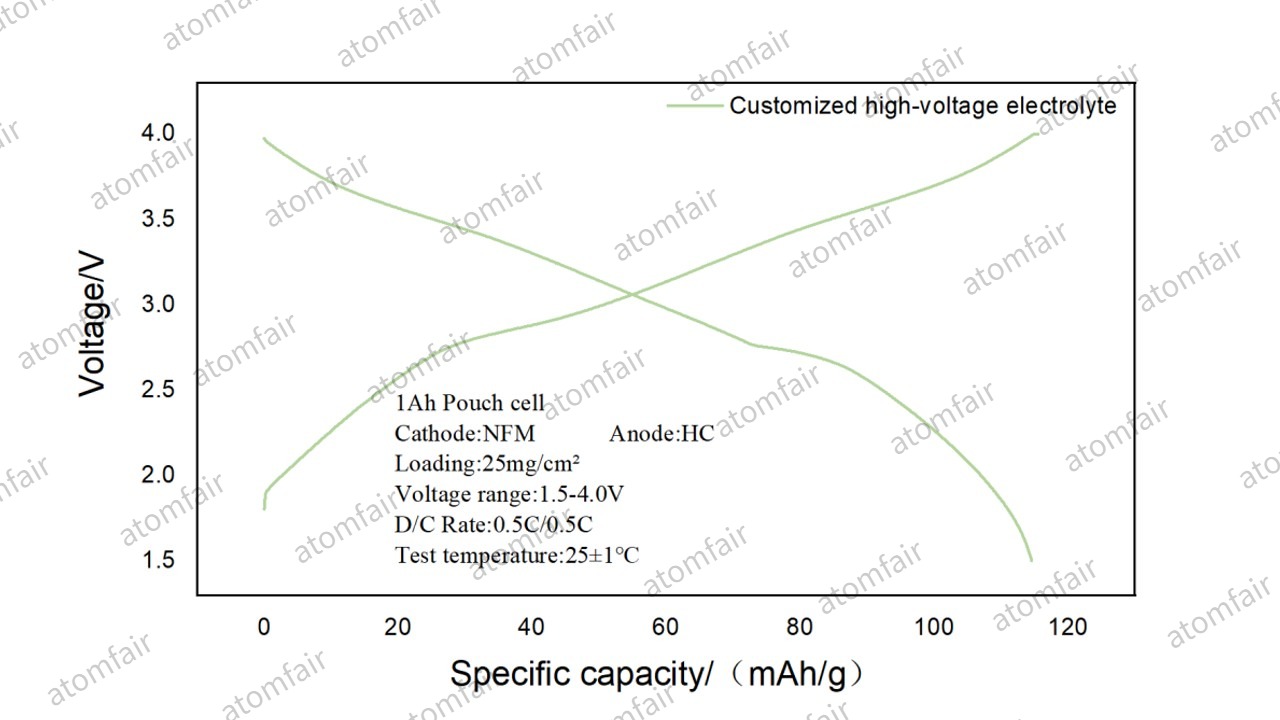
1. The 4.0V Window: The “Marathon Runner” Seeking Extreme Stability
- Performance Profile: Specific capacity remains at approximately 115 mAh/g with minimal polarization. The charge-discharge plateaus exhibit textbook-level symmetry.
- Technical Insights: This is the “safe zone” for the NFM111 cathode. If you are focusing on long-duration energy storage (LDES) or need to achieve limit-testing of 5,000+ cycles, locking the voltage at 4.0V and pairing it with our Customized Long-cycle Electrolyte is the most reliable path.
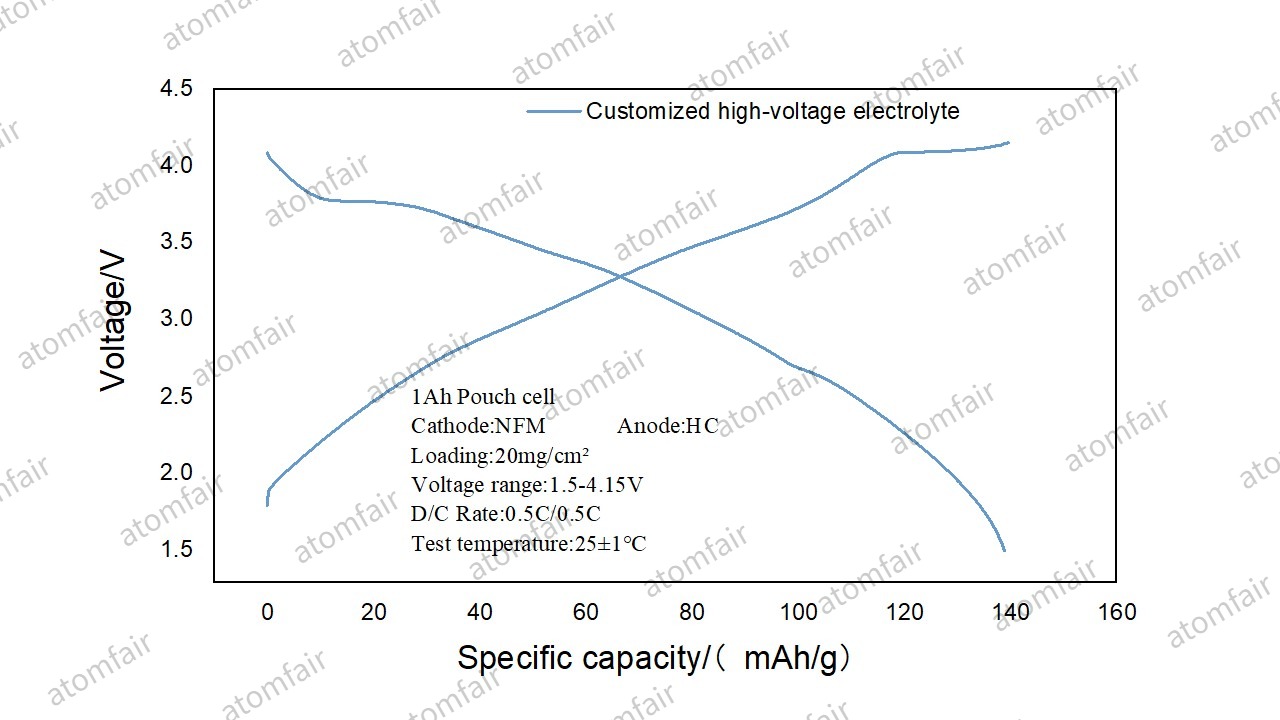
2. The 4.15V Window: The “Performance Watershed” for Energy Dividends
- Performance Profile: Increasing the upper voltage limit by 0.15V triggers an immediate surge in capacity to 139 mAh/g, resulting in a net energy density gain of 31%.
- Technical Insights: This is the “sweet spot” for cost-performance. The incremental capacity is almost entirely concentrated in the high-voltage plateau above 3.5V. For full-cell projects targeting high range, 4.15V represents the optimal solution for balancing cycle life and specific energy.
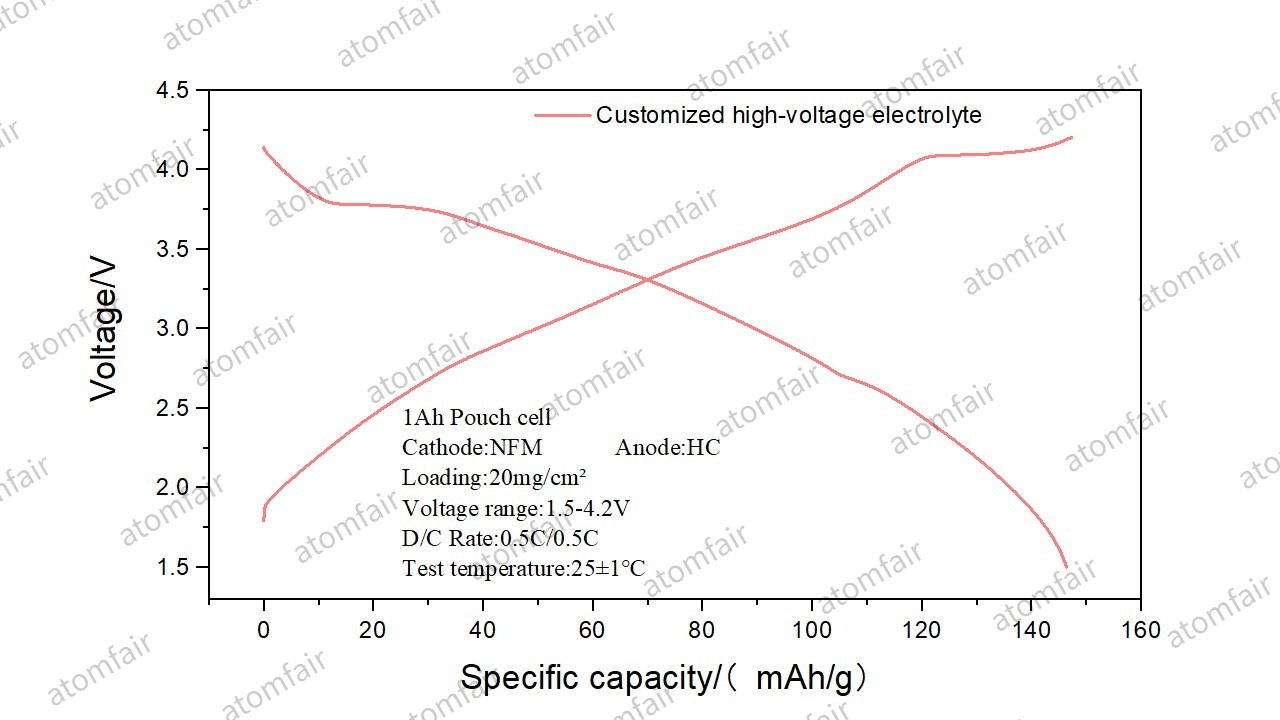
3. The 4.2V Window: The “Limit Climb” Challenging Physical Ceilings
- Performance Profile: Specific capacity reaches 146 mAh/g, pushing the material’s potential to its absolute limit.
- Technical Insights: This window is the primary domain for high-impact publications. However, be advised: interfacial stability at 4.2V depends entirely on the oxidative resistance of the electrolyte. Without the protection of an inorganic CEI film constructed by Customized High-Voltage Electrolytes, the material’s inherent advantages will be masked by severe interfacial side reactions.
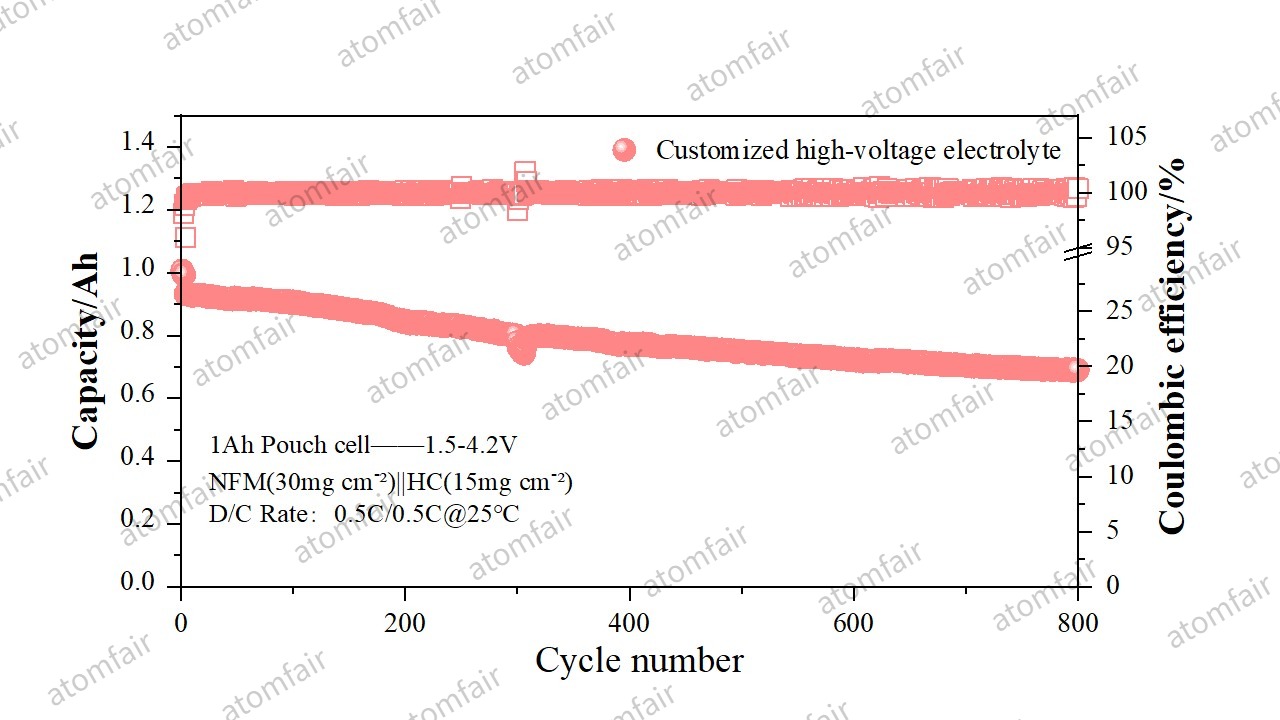
📈 Deep Deconstruction: The Reality of Cycling at 30 mg/cm² High Loading
The cycling curves in the lower-right corner reveal a critical “hardcore” detail often overlooked: areal mass loading.
While data from low loadings (~5 mg/cm²) are common in academic journals, they do not reflect real-world applications. This evaluation utilized an industrial-standard high loading of 30 mg/cm². Even under the extreme stress of 4.2V, the system maintained a robust curve for 800 cycles.
- Conclusion: This demonstrates that through the synergy of highly compatible hard carbon anodes and advanced interfacial engineering, the high-voltage limits of the NFM system are no longer “isolated lab data,” but are backed by the feasibility required for large-scale industrialization.
🛠️ Laboratory Selection Guide (Tips to Avoid Common Pitfalls)
- For Fundamental Mechanism Research: Start at 4.0V to eliminate high-voltage interference and focus on the material’s inherent phase transition laws.
- For Engineering Validation: Go directly to 4.15V. This is the critical battlefield where sodium-ion batteries compete directly with LFP energy densities.
- For Interfacial Breakthroughs: Challenge 4.2V. Use our High-Voltage System Components as a benchmark to explore and validate higher-activity electrolyte additives.
💡 Conclusion
The allure of the NFM-HC system lies in its immense degree of freedom for tuning. With the comprehensive material and data solutions provided by the Next-Gen Battery Laboratory, you can toggle between energy and longevity with the precision of a dial.
- Sodium-ion batteries: present and future
DOI: 10.1039/c6cs00776g
Comprehensive review relevant to sodium-ion battery commercialization, layered oxide cathodes, hard carbon anodes, electrolyte stability, and cycle-life versus energy-density tradeoffs. - Research Development on Sodium-Ion Batteries
DOI: 10.1021/cr500192f
Foundational sodium-ion battery review covering layered oxide cathodes, hard carbon anodes, full-cell design, and electrochemical testing concepts such as voltage windows and cycling behavior. - Sodium‐Ion Batteries
DOI: 10.1002/adfm.201200691
Broad authoritative review of sodium-ion battery chemistry, including cathode and anode material classes, electrochemical profiles, and full-cell development context.