Description
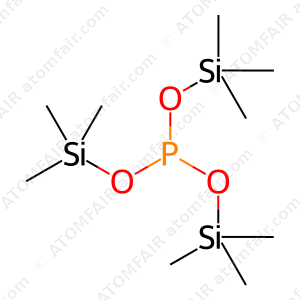
Tris(trimethylsilyl) phosphite (CAS No. 1795-31-9) is a high-purity organosilicon compound with the molecular formula C9H27O3PSi3. This specialty chemical is widely utilized in advanced electrochemical applications, particularly in lithium-ion battery systems, due to its unique ability to act as a stabilizing agent and electrolyte additive. Its structure features three trimethylsilyl groups bonded to a phosphite core, offering exceptional thermal and chemical stability under demanding conditions. Packaged under inert gas to ensure longevity, this product is available in rigorously tested batches with ≥98% purity (GC). Ideal for research and industrial applications, it is supplied in amber glass bottles or custom bulk quantities to meet specific experimental or production needs. Handle under nitrogen or argon to prevent moisture sensitivity.
Properties
- CAS Number: 1795-31-9
- Complexity: 179
- IUPAC Name: tris(trimethylsilyl) phosphite
- InChI: InChI=1S/C9H27O3PSi3/c1-14(2,3)10-13(11-15(4,5)6)12-16(7,8)9/h1-9H3
- InChI Key: VMZOBROUFBEGAR-UHFFFAOYSA-N
- Exact Mass: 298.10056132
- Molecular Formula: C9H27O3PSi3
- Molecular Weight: 298.54
- SMILES: C[Si](C)(C)OP(O[Si](C)(C)C)O[Si](C)(C)C
- Topological: 27.7
- Monoisotopic Mass: 298.10056132
- Synonyms: Tris(trimethylsilyl) phosphite, Silanol, 1,1,1-trimethyl-, 1,1′,1”-phosphite, 679-684-3, 1795-31-9, TRIS(TRIMETHYLSILYL)PHOSPHITE, Silanol, trimethyl-, phosphite (3:1), tritrimethylsilyl phosphite, Phosphorous Acid Tris(trimethylsilyl) Ester, Tris(trimethylsily)phosphite, C9H27O3PSi3, MFCD00015588, Trimethylsilanol phosphite, tris-trimethylsilylphosphite, SCHEMBL269960, DTXSID70170820, GEO-02592, Tris(Trimethylsilyl) Phosphite, 96%, AKOS015856795, Phosphorous acid tris(trimethylsilyl)ester, DB-024386, P1217, Phosphorous acid, tris(trimethylsilyl) ester, EN300-31292, D92090, Tris(trimethylsilyl) phosphite, >=95.0% (GC), Silanol,1,1,1-trimethyl-, 1,1′,1”-phosphite
Application
Tris(trimethylsilyl) phosphite serves as a critical electrolyte additive in lithium-ion batteries, enhancing thermal stability and cycle life by forming protective SEI layers on electrodes. Its moisture-scavenging properties improve electrolyte performance in high-energy-density systems. Researchers also employ it as a phosphite precursor in organometallic synthesis and surface modification protocols.
Safety and Hazards
GHS Hazard Statements
- H315 (95.7%): Causes skin irritation [Warning Skin corrosion/irritation]
- H319 (95.7%): Causes serious eye irritation [Warning Serious eye damage/eye irritation]
Precautionary Statements
- P264, P264+P265, P280, P302+P352, P305+P351+P338, P321, P332+P317, P337+P317, and P362+P364
Hazard Classes and Categories
- Skin Irrit. 2 (95.7%)
- Eye Irrit. 2 (95.7%)
If you are interested or have any questions, please contact us at support@atomfair.com
Disclaimer: Sold exclusively for laboratory research. Prohibited for commercial use, diagnostics, or human/animal applications. Buyers assume all compliance liability.
Reviews
There are no reviews yet.