Description
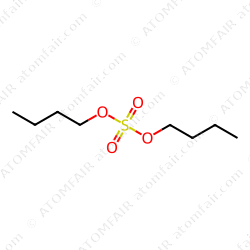
Sulfuric acid, dibutyl ester (Dibutyl sulfate) is a high-purity organic sulfate ester with the molecular formula C8H18O4S (CAS No. 625-22-9). This colorless to pale yellow liquid is widely utilized in synthetic organic chemistry and industrial applications due to its role as an alkylating agent and intermediate. With a boiling point of approximately 280-290°C and a density of 1.06 g/cm3, it is soluble in common organic solvents but reacts vigorously with water. Our product is rigorously tested for purity (≥98% by GC) and is supplied in amber glass bottles or specialized chemical-resistant containers to ensure stability. Ideal for laboratory-scale reactions and process optimization, this compound requires handling under inert conditions due to its moisture sensitivity. Store in a cool, dry place with proper ventilation.
Properties
- CAS Number: 625-22-9
- Complexity: 177
- IUPAC Name: dibutyl sulfate
- InChI: InChI=1S/C8H18O4S/c1-3-5-7-11-13(9,10)12-8-6-4-2/h3-8H2,1-2H3
- InChI Key: LMEDOLJKVASKTP-UHFFFAOYSA-N
- Exact Mass: 210.09258022
- Molecular Formula: C8H18O4S
- Molecular Weight: 210.29
- SMILES: CCCCOS(=O)(=O)OCCCC
- Topological: 61
- Monoisotopic Mass: 210.09258022
- Synonyms: Dibutyl sulfate, 625-22-9, Dibutylsulfate, Di-n-butyl sulphate, SULFURIC ACID, DIBUTYL ESTER, Dibutyl sulphate, Sulphuric acid dibutyl ester, BRN 1707498, CCRIS 9255, DTXSID80211536, 4-01-00-01523 (Beilstein Handbook Reference), DTXCID10134027, 613-047-2, lmedoljkvasktp-uhfffaoysa-n, Di-n-butyl sulfate, di-n-butylsulfate, Di-n-butylsulfat, sulfuric acid dibutyl ester, MFCD00059420, Di-n-butylsulfat [German], dibutylsulfat, E77NH8S3QP, SCHEMBL19733, AKOS025396836, FD35999, BS-22310, SY050073, DB-230193, CS-0206817, D1633, NS00035058, D95290, A833825, Q9336200
Application
Dibutyl sulfate is primarily employed as an alkylating agent in the synthesis of specialty chemicals and pharmaceuticals. It serves as a key intermediate in the production of surfactants and ester derivatives. Researchers also utilize it in polymer modification and catalysis studies. Its reactivity makes it valuable for quaternary ammonium compound synthesis.
Safety and Hazards
GHS Hazard Statements
- H302 (97.7%): Harmful if swallowed [Warning Acute toxicity, oral]
Precautionary Statements
- P264, P270, P301+P317, P330, and P501
Hazard Classes and Categories
- Acute Tox. 4 (97.7%)
If you are interested or have any questions, please contact us at support@atomfair.com
Disclaimer: Sold exclusively for laboratory research. Prohibited for commercial use, diagnostics, or human/animal applications. Buyers assume all compliance liability.
Reviews
There are no reviews yet.