Description
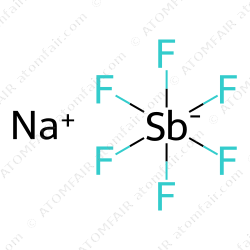
Sodium Hexafluoroantimonate (NaSbF6) is a high-purity inorganic compound widely used in electrochemical applications and as a fluorinating agent in organic synthesis. With the molecular formula F6NaSb and CAS number 16925-25-0, this white crystalline solid exhibits excellent solubility in polar solvents, making it ideal for research and industrial processes. Its robust thermal stability and reactivity with Lewis acids render it valuable in catalysis, battery electrolytes, and specialty material synthesis. Packaged under controlled conditions to ensure stability, our product meets stringent quality standards for researchers and scientists requiring reliable performance in advanced chemical applications.
Properties
- CAS Number: 16925-25-0
- Complexity: 62.7
- IUPAC Name: sodium;hexafluoroantimony(1-)
- InChI: InChI=1S/6FH.Na.Sb/h6*1H;;/q;;;;;;+1;+5/p-6
- InChI Key: HKLMYZVMEYYVBS-UHFFFAOYSA-H
- Exact Mass: 257.88400
- Molecular Formula: F6NaSb
- Molecular Weight: 258.740
- SMILES: F[Sb-](F)(F)(F)(F)F.[Na+]
- Monoisotopic Mass: 257.88400
- Physical Description: Beige powder;
- Synonyms: Sodium hexafluoroantimonate, Sodium hexafluoroantimonate(V), sodium hexafluorostibanuide, 7JW6105AEM, Antimonate(1-), hexafluoro-, sodium, (OC-6-11)-, SODIUM HEXAFLUOROANTIMONATE, NaSbF6, Sodium hexafluoroantimonic acid, DTXCID501437083, Antimonate(1), hexafluoro, sodium, (OC611), Antimonate(1), hexafluoro, sodium (1:1), (OC611), 240-989-8, antimonate(1-), hexafluoro-, sodium (1:1), (oc-6-11)-, dtxsid301014504, einecs 240-989-8, unii-7jw6105aem, 16925-25-0, sodium;hexafluoroantimony(1-), sodium hexafluorostiboranuide, NaSbF6, MFCD00003482, Sodium hexafluoroantimony, hexafluorostibine, sodium salt, SODIUMHEXAFLUOROANTIMONATE, SCHEMBL27612951, SBB102090, AKOS015904237, DB-064729, NS00085322, E75939, Q4134941
Sodium hexafluoroantimonate is primarily employed as a fluorinating agent in organic synthesis, facilitating the introduction of fluorine atoms into complex molecules. It serves as a key component in lithium-ion battery electrolytes due to its ability to enhance ionic conductivity and electrochemical stability. Additionally, its role as a Lewis acid catalyst is critical in polymerization and other industrial chemical processes.
Safety and Hazards
GHS Hazard Statements
- H320: Causes eye irritation [Warning Serious eye damage/eye irritation]
- H335: May cause respiratory irritation [Warning Specific target organ toxicity, single exposure; Respiratory tract irritation]
- H351: Suspected of causing cancer [Warning Carcinogenicity]
- H372: Causes damage to organs through prolonged or repeated exposure [Danger Specific target organ toxicity, repeated exposure]
Precautionary Statements
- P203, P260, P261, P264, P264+P265, P270, P271, P280, P304+P340, P305+P351+P338, P318, P319, P337+P317, P403+P233, P405, and P501
Hazard Classes and Categories
- Serious eye damage/eye irritation – Category 2B
- Carcinogenicity – Category 2
- Specific target organ toxicity – Single exposure – Category 3
- Specific target organ toxicity – Repeated exposure – Category 1
If you are interested or have any questions, please contact us at support@atomfair.com
Disclaimer: Sold exclusively for laboratory research. Prohibited for commercial use, diagnostics, or human/animal applications. Buyers assume all compliance liability.
Reviews
There are no reviews yet.