Description
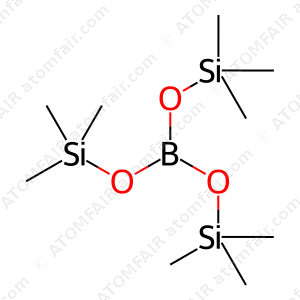
Tris(trimethylsilyl) borate (CAS No. 4325-85-3) is a high-purity organosilicon compound with the molecular formula C9H27BO3Si3. This specialty chemical is widely utilized in advanced research and industrial applications due to its unique boron-silicon coordination. The compound features three trimethylsilyl groups bonded to a central borate core, offering exceptional thermal stability and reactivity in synthetic processes. Our product is rigorously tested to ensure >98% purity (GC) with minimal trace metals, making it ideal for sensitive applications in materials science, catalysis, and surface modification. Supplied in amber glass bottles under inert gas to prevent hydrolysis, this reagent is a valuable tool for researchers developing novel silicon-based materials or boron-doped systems.
Properties
- CAS Number: 4325-85-3
- Complexity: 179
- IUPAC Name: tris(trimethylsilyl) borate
- InChI: InChI=1S/C9H27BO3Si3/c1-14(2,3)11-10(12-15(4,5)6)13-16(7,8)9/h1-9H3
- InChI Key: YZYKZHPNRDIPFA-UHFFFAOYSA-N
- Exact Mass: 278.1361045
- Molecular Formula: C9H27BO3Si3
- Molecular Weight: 278.38
- SMILES: B(O[Si](C)(C)C)(O[Si](C)(C)C)O[Si](C)(C)C
- Topological: 27.7
- Monoisotopic Mass: 278.1361045
- Synonyms: Tris(trimethylsilyl) borate, Silanol, 1,1,1-trimethyl-, 1,1′,1”-triester with boric acid (H3BO3), 629-367-0, 4325-85-3, Tris(trimethylsiloxy)boron, Tris(trimethylsilyl)borate, tritrimethylsilyl borate, Silanol, trimethyl-, triester with boric acid (H3BO3), MFCD00051588, Borane, tris(trimethylsiloxy)-, Tris(trimethylsiloxy)borane, SCHEMBL51346, Boric acid, 3TMS derivative, DTXSID3063413, Tris(trimethylsilyl) borate, 99%, Silanol, trimethyl-, borate (3:1), AKOS015833572, FS-5029, s21250, CS-0168506, T2543, D92611, EN300-201302, Tris(trimethylsilyl)borate(Tris(trimethylsiloxy)boron), F0001-1193
Application
Tris(trimethylsilyl) borate serves as a versatile boron source in the synthesis of advanced ceramics and glass materials. It acts as a crosslinking agent in silicone polymer formulations, enhancing thermal resistance. The compound finds particular utility as a precursor for chemical vapor deposition (CVD) of boron-containing thin films. Researchers also employ it as a Lewis acid catalyst in organic transformations involving silyl protection strategies.
Safety and Hazards
GHS Hazard Statements
- H226 (100%): Flammable liquid and vapor [Warning Flammable liquids]
- H315 (100%): Causes skin irritation [Warning Skin corrosion/irritation]
- H319 (100%): Causes serious eye irritation [Warning Serious eye damage/eye irritation]
- H335 (98.6%): May cause respiratory irritation [Warning Specific target organ toxicity, single exposure; Respiratory tract irritation]
Precautionary Statements
- P210, P233, P240, P241, P242, P243, P261, P264, P264+P265, P271, P280, P302+P352, P303+P361+P353, P304+P340, P305+P351+P338, P319, P321, P332+P317, P337+P317, P362+P364, P370+P378, P403+P233, P403+P235, P405, and P501
Hazard Classes and Categories
- Flam. Liq. 3 (100%)
- Skin Irrit. 2 (100%)
- Eye Irrit. 2 (100%)
- STOT SE 3 (98.6%)
If you are interested or have any questions, please contact us at support@atomfair.com
Disclaimer: Sold exclusively for laboratory research. Prohibited for commercial use, diagnostics, or human/animal applications. Buyers assume all compliance liability.
Reviews
There are no reviews yet.