Description
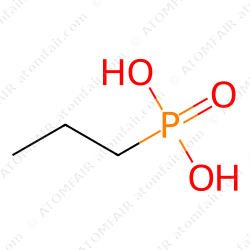
Propylphosphonic Acid (CAS No. 4672-38-2) is a high-purity organophosphorus compound with the molecular formula C3H9O3P. This versatile chemical is widely used in organic synthesis, coordination chemistry, and materials science due to its unique phosphonic acid functional group. Our product is rigorously tested to ensure >98% purity (HPLC) and is supplied as a white crystalline solid with excellent stability under standard storage conditions.
Key features include:
- IUPAC Name: Propylphosphonic acid
- Molecular Weight: 124.07 g/mol
- Melting Point: ~85-88°C
- Solubility: Soluble in water, alcohols, and polar organic solvents
- Packaging: Available in 1g, 5g, 25g, and 100g quantities with optional argon-packed vials for oxygen-sensitive applications
Ideal for:
- Ligand synthesis for metal-organic frameworks (MOFs)
- Surface modification of metal oxides
- Pharmaceutical intermediates
- Corrosion inhibition studies
Properties
- CAS Number: 4672-38-2
- Complexity: 84.2
- IUPAC Name: propylphosphonic acid
- InChI: InChI=1S/C3H9O3P/c1-2-3-7(4,5)6/h2-3H2,1H3,(H2,4,5,6)
- InChI Key: NSETWVJZUWGCKE-UHFFFAOYSA-N
- Exact Mass: 124.02893114
- Molecular Formula: C3H9O3P
- Molecular Weight: 124.08
- SMILES: CCCP(=O)(O)O
- Topological: 57.5
- Monoisotopic Mass: 124.02893114
- Synonyms: Propylphosphonic acid, 4672-38-2, Phosphonic acid, P-propyl-, 225-121-8, nsetwvjzuwgcke-uhfffaoysa-n, Propane-1-phosphonic acid, Propyl-phosphonic acid, n-propylphosphonic acid, MFCD00012294, CHEMBL125296, 1-Propylphosphonicacid, 1-Propylphosphonic acid cyclic anhydride, 1-propyl phosphonic acid cyclic anhydride, Propylphosphonic acid, 95%, SCHEMBL55254, SCHEMBL94616, SCHEMBL480342, SCHEMBL1303156, SCHEMBL8388777, SCHEMBL8388780, DTXSID20871092, BDBM50131864, AKOS015892844, 1-propylphosphonic-acid cyclic anhydride, DB-051398, NS00005426, C15829
Application
Propylphosphonic acid serves as a key building block in the synthesis of functionalized phosphonates for material science applications. Researchers utilize this compound to create self-assembled monolayers on metal oxide surfaces, particularly in sensor development. In coordination chemistry, it acts as a versatile ligand for constructing metal-organic frameworks with tunable porosity. The compound also finds use in developing proton-conducting materials for fuel cell technologies.
Safety and Hazards
GHS Hazard Statements
- H314 (100%): Causes severe skin burns and eye damage [Danger Skin corrosion/irritation]
Precautionary Statements
- P260, P264, P280, P301+P330+P331, P302+P361+P354, P304+P340, P305+P354+P338, P316, P321, P363, P405, and P501
Hazard Classes and Categories
- Skin Corr. 1B (100%)
If you are interested or have any questions, please contact us at support@atomfair.com
Disclaimer: Sold exclusively for laboratory research. Prohibited for commercial use, diagnostics, or human/animal applications. Buyers assume all compliance liability.
Reviews
There are no reviews yet.