Description
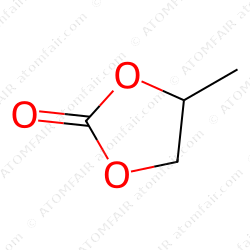
Propylene Carbonate (CAS 108-32-7) is a high-purity, cyclic carbonate solvent with the molecular formula C4H6O3 and IUPAC name 4-methyl-1,3-dioxolan-2-one. This versatile, aprotic solvent is renowned for its exceptional solvency power, high boiling point (242°C), and low volatility, making it ideal for demanding applications in research and industrial processes. Its high dielectric constant (64.92 at 25°C) and wide electrochemical stability window (+5V vs. Li/Li+) render it invaluable in lithium-ion battery electrolytes. Propylene Carbonate is also prized for its biodegradability and low toxicity, meeting stringent environmental and safety standards. Available in anhydrous (≤50 ppm H2O) and battery-grade purities (99.99%), our product undergoes rigorous QC testing including GC, Karl Fischer titration, and ICP-MS analysis to ensure batch-to-batch consistency for sensitive applications.
Properties
- CAS Number: 108-32-7
- Complexity: 88.9
- IUPAC Name: 4-methyl-1,3-dioxolan-2-one
- InChI: InChI=1S/C4H6O3/c1-3-2-6-4(5)7-3/h3H,2H2,1H3
- InChI Key: RUOJZAUFBMNUDX-UHFFFAOYSA-N
- LogP: log Kow = -0.41
- Exact Mass: 102.031694049
- Molecular Formula: C4H6O3
- Molecular Weight: 102.09
- SMILES: CC1COC(=O)O1
- Topological: 35.5
- Monoisotopic Mass: 102.031694049
- Physical Description: Liquid
- Color/Form: Colorless liquid
- Odor: Odorless
- Boiling Point: 241.6 °C
- Melting Point: -48.8 °C
- Flash Point: 116 °C – closed cup
- Solubility: In water, 1.75X10+5 mg/L at 25 °C
- Density: 1.2047 g/cu cm at 20 °C
- Vapor Pressure: 0.04 [mmHg]
- Stability/Shelf Life: Stable under recommended storage conditions.
- Refractive Index: Index of refraction: 1.4189 at 20 °C/D
- Synonyms: PROPYLENE CARBONATE, 108-32-7, 4-Methyl-1,3-dioxolan-2-one, 1,2-Propylene carbonate, 1,2-Propanediol cyclic carbonate, Texacar PC, Arconate 5000, Cyclic propylene carbonate, 1,2-Propanediol carbonate, Dipropylene carbonate, 1-Methylethylene carbonate, 4-Methyldioxalone-2, 1,2-Propanediyl carbonate, Cyclic 1,2-propylene carbonate, Propylene glycol cyclic carbonate, Cyclic methylethylene carbonate, 4-Methyl-2-oxo-1,3-dioxolane, Carbonic acid, propylene ester, NSC 11784, Carbonic acid, cyclic propylene ester, Propylenester kyseliny uhlicite, HSDB 6806, Carbonic acid cyclic methylethylene ester, EINECS 203-572-1, Carbonic acid, cyclic propylene ether, NSC-11784, UNII-8D08K3S51E, BRN 0107913, DTXSID2026789, AI3-19724, 8D08K3S51E, DTXCID006789, EC 203-572-1, 5-19-04-00021 (Beilstein Handbook Reference), PROPYLENE CARBONATE (II), PROPYLENE CARBONATE [II], PROPYLENE CARBONATE (MART.), PROPYLENE CARBONATE [MART.], PROPYLENE CARBONATE (USP-RS), PROPYLENE CARBONATE [USP-RS], 1,3-dioxolane-2-one, 4-methyl, 203-572-1, 1,3-Dioxolan-2-one, 4-methyl-, Propylenecarbonate, 99%, Propylene carbonate [NF], Propylene carbonate (NF), WLN: T5OVOTJ D, CAS-108-32-7, PC-HP, MFCD00005385, 4-methyl-1,3-dioxolane-2-one, Propylenester kyseliny uhlicite [Czech], MFCD00798264, MFCD00798265, propylenecarbonate, Solvenon PC, propylen carbonate, Propylene carbonate(PC), Arconate propylene carbonate, SCHEMBL15309, R-1,2-Propanediol carbonate, SCHEMBL253584, SCHEMBL905652, 1-propanediol cyclic carbonate, SCHEMBL9179119, (S)-1,2-Propanediol carbonate, CHEMBL1733973, 2-Oxo-4-methyl-1,3-dioxolane, 1,2-PDC, 4-methyl-[1,3]dioxolan-2-one, NSC1913, CHEBI:231185, PROPYLENE CARBONATE [HSDB], PROPYLENE CARBONATE [VANDF], NSC-1913, NSC11784, Propylene carbonate (Battery grade), Tox21_202047, Tox21_303214, BBL027518, STL373011, AKOS009158417, (S)-1,2-Propanediol cyclic carbonate, FP40326, SB66353, Propylene carbonate, anhydrous, 99.7%, NCGC00165974-01, NCGC00165974-02, NCGC00256995-01, NCGC00259596-01, Propylene carbonate, for HPLC, 99.7%, BP-30108, BP-31155, SY008770, SY066861, DB-018081, Propylene carbonate, ReagentPlus(R), 99%, CS-0076373, NS00004305, P0525, D05633, EN300-296359, Propylene carbonate, anhydrous, Water 50ppm Max., Propylene carbonate, Selectophore(TM), >=99.0%, Q415979, Propylene carbonate, Vetec(TM) reagent grade, 98%, F0001-0165, Propylene carbonate, >=99%, acid <10 ppm, H2O <10 ppm, 1,2-Propanediol cyclic carbonate, 4-Methyl-1,3-dioxolan-2-one, Propylene carbonate, United States Pharmacopeia (USP) Reference Standard, 110320-40-6
Application
Propylene Carbonate serves as a premier solvent for lithium battery electrolytes due to its exceptional ionic conductivity and wide liquid temperature range (-49°C to 242°C). In organic synthesis, it facilitates reactions as a green alternative to traditional dipolar aprotic solvents. The compound finds significant use as a industrial paint stripper and degreaser owing to its powerful solvency for resins and polymers. Its high dielectric constant makes it valuable in capacitor formulations and specialty coatings. Additionally, it functions as a precision cleaning agent in electronics manufacturing where residue-free performance is critical.
Safety and Hazards
GHS Hazard Statements
- H319: Causes serious eye irritation [Warning Serious eye damage/eye irritation]
Precautionary Statements
- P264+P265, P280, P305+P351+P338, and P337+P317
Hazard Classes and Categories
- Eye Irrit. 2 (> 99.9%)
If you are interested or have any questions, please contact us at support@atomfair.com
Disclaimer: Sold exclusively for laboratory research. Prohibited for commercial use, diagnostics, or human/animal applications. Buyers assume all compliance liability.
Reviews
There are no reviews yet.