Description
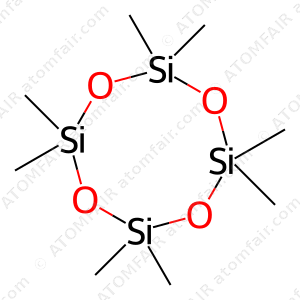
Octamethylcyclotetrasiloxane (CAS 556-67-2) is a high-purity cyclic siloxane with the molecular formula C8H24O4Si4. This organosilicon compound, also known by its IUPAC name 2,2,4,4,6,6,8,8-octamethyl-1,3,5,7,2,4,6,8-tetraoxatetrasilocane, is widely used in industrial and research applications due to its excellent thermal stability, low viscosity, and hydrophobicity. It serves as a key intermediate in the synthesis of silicone polymers, lubricants, and personal care products. Our product is rigorously tested to ensure optimal purity and consistency, making it ideal for precision formulations and advanced material science applications. Available in various quantities to meet both laboratory and bulk production needs.
Properties
- CAS Number: 556-67-2
- Complexity: 197
- IUPAC Name: 2,2,4,4,6,6,8,8-octamethyl-1,3,5,7,2,4,6,8-tetraoxatetrasilocane
- InChI: InChI=1S/C8H24O4Si4/c1-13(2)9-14(3,4)11-16(7,8)12-15(5,6)10-13/h1-8H3
- InChI Key: HMMGMWAXVFQUOA-UHFFFAOYSA-N
- LogP: log Kow = 6.74
- Exact Mass: 296.07516538
- Molecular Formula: C8H24O4Si4
- Molecular Weight: 296.61
- SMILES: C[Si]1(O[Si](O[Si](O[Si](O1)(C)C)(C)C)(C)C)C
- Topological: 36.9
- Monoisotopic Mass: 296.07516538
- Physical Description: Liquid
- Color/Form: Oily liquid
- Boiling Point: 175 °C
- Melting Point: 17.5 °C
- Flash Point: 55 °C – closed cup
- Solubility: In water, 0.056 mg/L at 23 °C
- Density: Specific gravity: 0.9558
- Vapor Pressure: 1.05 [mmHg]
- Henry’s Law Constant: Henry’s Law constant = 13.4 atm-cu m/mol at 25 °C
- Stability/Shelf Life: Stable under recommended storage conditions.
- Viscosity: 2.30 cSt at 25 °C
- Heat of Vaporization: Enthalpy of vaporization: 44.1-48.5 kJ/mol
- Refractive Index: Index of refraction: 1.3968 at 20 °C/D
- Synonyms: OCTAMETHYLCYCLOTETRASILOXANE, 556-67-2, Cyclotetrasiloxane, octamethyl-, 2,2,4,4,6,6,8,8-Octamethyl-1,3,5,7,2,4,6,8-tetraoxatetrasilocane, Oktamethylcyklotetrasiloxan, OMCTS, Cyclic dimethylsiloxane tetramer, NUC silicone VS 7207, Union carbide 7207, Silicone SF 1173, Cyclomethicone 4, Oktamethylzyklotetrasiloxan, CCRIS 1327, HSDB 6131, Oktamethylcyklotetrasiloxan [Czech], EINECS 209-136-7, KF 994, NSC 345674, UNII-CZ227117JE, SF 1173, UC 7207, VS 7207, BRN 1787074, DTXSID7027205, CHEBI:25640, NSC-345674, 2,2,4,4,6,6,8,8-octamethyl-1,3,5,7,2,4,6,8-tetroxatetrasilocane, DTXCID107205, HMMGMWAXVFQUOA-UHFFFAOYSA-, OCTAMETHYCYCLOTETRASILOXANE, EC 209-136-7, CYCLOMETHICONE 4 [USP-RS], 4-04-00-04125 (Beilstein Handbook Reference), CYCLOTETRASILOXANE, OCTAMETHYL, CO9810, OCTAMETHYLCYCLOTETRASILOXANE [MI], OCTAMETHYLCYCLOTETRASILOXANE [HSDB], O9810, CYCLOMETHICONE 4 (USP-RS), Oktamethylcyklotetrasiloxane, 2,2,4,4,6,6,8,8-Octamethylcyclotetrasiloxane, Cyclotetrasiloxane, 2,2,4,4,6,6,8,8octamethyl, hmmgmwaxvfquoa-uhfffaoysa-n, inchi=1/c8h24o4si4/c1-13(2)9-14(3,4)11-16(7,8)12-15(5,6)10-13/h1-8h3, Dimethylsiloxane Cyclic Tetramer, CZ227117JE, MFCD00003269, CAS-556-67-2, bmse000765, octamethyl-cyclotetrasiloxane, SCHEMBL18354, BIDD:ER0157, CHEMBL1869229, Octamethylcyclotetrasiloxane, 98%, Tox21_201398, Tox21_300547, MSK002144, NSC345674, AKOS008901191, NCGC00164099-01, NCGC00164099-02, NCGC00164099-03, NCGC00254406-01, NCGC00258949-01, 1ST002144, MSK002144-1000, CS-0213747, NS00043628, O0142, F83065, Octamethylcyclotetrasiloxane, analytical standard, 1ST002144-1000, Cyclotetrasiloxane, 2,2,4,4,6,6,8,8-octamethyl-, Q2013804, Octamethylcyclotetrasiloxane Solution in Methanol, 1000?g/mL, Octamethylcyclotetrasiloxane Solution in Methanol, 1000mug/mL, 2,2,4,4,6,6,8,8-Octamethyl-1,3,5,7,2,4,6,8-tetraoxatetrasilocane #, Cyclomethicone 4, United States Pharmacopeia (USP) Reference Standard, D4 Cyclomethicone, Pharmaceutical Secondary Standard; Certified Reference Material, d-4
Application
Octamethylcyclotetrasiloxane is primarily used as a precursor in the production of polydimethylsiloxanes (PDMS) and other silicone-based materials. It finds applications in cosmetics, where it acts as an emollient and carrier fluid due to its smooth texture and volatility. Additionally, it is employed in industrial lubricants, dielectric fluids, and as a solvent in chemical synthesis. Its thermal stability also makes it suitable for high-temperature applications in coatings and elastomers.
Safety and Hazards
GHS Hazard Statements
- H226: Flammable liquid and vapor [Warning Flammable liquids]
- H361: Suspected of damaging fertility or the unborn child [Warning Reproductive toxicity]
- H413: May cause long lasting harmful effects to aquatic life [Hazardous to the aquatic environment, long-term hazard]
Precautionary Statements
- P203, P210, P233, P240, P241, P242, P243, P273, P280, P303+P361+P353, P318, P370+P378, P403+P235, P405, and P501
Hazard Classes and Categories
- Flam. Liq. 3 (72.1%)
- Repr. 2 (96%)
- Aquatic Chronic 4 (89.7%)
If you are interested or have any questions, please contact us at support@atomfair.com
Disclaimer: Sold exclusively for laboratory research. Prohibited for commercial use, diagnostics, or human/animal applications. Buyers assume all compliance liability.
Reviews
There are no reviews yet.