Description
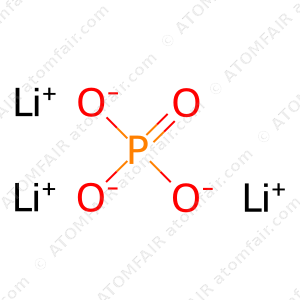
Lithium Phosphate (Li3PO4) is a high-purity inorganic compound widely utilized in advanced research and industrial applications due to its exceptional ionic conductivity and thermal stability. This anhydrous, crystalline powder is synthesized under stringent conditions to ensure minimal impurities, making it ideal for lithium-ion battery electrolytes, ceramic materials, and solid-state electrochemical devices. With a molecular formula of Li3O4P and CAS No. 10377-52-3, our Lithium Phosphate boasts a purity of ≥98%, validated by rigorous analytical techniques including XRD and ICP-MS. Its uniform particle size distribution and low moisture content enhance performance in thin-film coatings, energy storage systems, and specialty glass formulations. Packaged under inert conditions to prevent degradation, this product meets the exacting standards of researchers and engineers working on next-generation technologies.
Properties
- CAS Number: 10377-52-3
- Complexity: 36.8
- IUPAC Name: trilithium;phosphate
- InChI: InChI=1S/3Li.H3O4P/c;;;1-5(2,3)4/h;;;(H3,1,2,3,4)/q3*+1;/p-3
- InChI Key: TWQULNDIKKJZPH-UHFFFAOYSA-K
- Exact Mass: 116.0014308
- Molecular Formula: Li3O4P
- Molecular Weight: 115.9
- SMILES: [Li+].[Li+].[Li+].[O-]P(=O)([O-])[O-]
- Topological: 86.3
- Monoisotopic Mass: 116.0014308
- Physical Description: Dry Powder
- Synonyms: Lithium phosphate, Phosphoric acid, trilithium salt, UNII-2QM4K05Q74, 2QM4K05Q74, EINECS 233-823-0, TRILITHIUM MONOPHOSPHATE, LITHIUM TRIBASIC PHOSPHATE, EC 233-823-0, Lithium Phosphoricum, 10377-52-3, Trilithium orthophosphate, Lithium orthophosphate, trilithium;phosphate, 10102-26-8, Phosphoric acid, lithium salt (1:3), MFCD00016187, Lithiumphosphate, Li3O4P, Li3PO4, Lithium phosphate anhydrous, Lithium phosphate, ? 98%, SCHEMBL64746, Lithium orthophosphate, 98%, Lithium phosphate, Puratronic?, DTXSID60889590, LITHIUM PHOSPHATE [WHO-DD], AKOS015903954, AKOS025243388, SY009969, L0374, Manganese Nitride ( MnN) Sputtering Targets, Q426354
Lithium Phosphate is primarily employed as a solid electrolyte in lithium-ion batteries due to its high ionic conductivity and electrochemical stability. It serves as a key component in ceramic materials for high-temperature applications, including thermal barrier coatings and proton-conducting membranes. Researchers also utilize it in the development of optical waveguides and biocompatible coatings for medical implants.
Safety and Hazards
GHS Hazard Statements
- H302 (100%): Harmful if swallowed [Warning Acute toxicity, oral]
- H315 (25%): Causes skin irritation [Warning Skin corrosion/irritation]
- H319 (79.2%): Causes serious eye irritation [Warning Serious eye damage/eye irritation]
- H335 (22.4%): May cause respiratory irritation [Warning Specific target organ toxicity, single exposure; Respiratory tract irritation]
Precautionary Statements
- P261, P264, P264+P265, P270, P271, P280, P301+P317, P302+P352, P304+P340, P305+P351+P338, P319, P321, P330, P332+P317, P337+P317, P362+P364, P403+P233, P405, and P501
Hazard Classes and Categories
- Acute Tox. 4 (100%)
- Skin Irrit. 2 (25%)
- Eye Irrit. 2 (79.2%)
- STOT SE 3 (22.4%)
If you are interested or have any questions, please contact us at support@atomfair.com
Disclaimer: Sold exclusively for laboratory research. Prohibited for commercial use, diagnostics, or human/animal applications. Buyers assume all compliance liability.
Reviews
There are no reviews yet.