Description
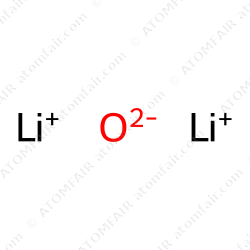
Lithium Oxide (Li2O) is a high-purity inorganic compound widely utilized in advanced material science and industrial applications. This white, crystalline solid is known for its exceptional reactivity with water and acids, making it a critical precursor in the synthesis of lithium-based ceramics, glasses, and electrolytes. With a CAS number of 12057-24-8, our Lithium Oxide is manufactured under stringent quality controls to ensure minimal impurities, ideal for research laboratories and high-tech manufacturing processes. Its high thermal stability and ionic conductivity also render it valuable in solid-state battery development and nuclear fusion research. Available in various granular sizes and purities, this product is packaged under inert conditions to maintain its integrity.
Properties
- CAS Number: 12057-24-8
- IUPAC Name: dilithium;oxygen(2-)
- InChI: InChI=1S/2Li.O/q2*+1;-2
- InChI Key: FUJCRWPEOMXPAD-UHFFFAOYSA-N
- Exact Mass: 30.02692149
- Molecular Formula: Li2O
- Molecular Weight: 29.9
- SMILES: [Li+].[Li+].[O-2]
- Topological: 1
- Monoisotopic Mass: 30.02692149
- Physical Description: Other Solid
- Synonyms: Lithium oxide, 12057-24-8, Dilithium monoxide, Lithia, 2ON0O9YI0Q, Lithium Oxydatum, einecs 235-019-5, unii-2on0o9yi0q, MFCD00016183, 12142-77-7, Lithium oxide (LiO), Lithium monoxide, Lithium monooxide, Monolithium monoxide, lithium(I) oxide, dilithium;oxygen(2-), Lithium Oxide (2/1), LITHIUM OXIDE [MI], SCHEMBL28778, DTXSID90923799, FUJCRWPEOMXPAD-UHFFFAOYSA-N, AKOS015903695, AKOS025310872, L0403, H11339, Q385662
Lithium Oxide is primarily used in the production of specialty glasses and ceramics due to its ability to modify thermal expansion properties. It serves as a key component in lithium-ion battery electrolytes, enhancing conductivity and stability. Additionally, Li2O is employed in nuclear applications as a neutron absorber and in chemical synthesis as a strong base or desiccant.
Safety and Hazards
GHS Hazard Statements
- H314 (76.2%): Causes severe skin burns and eye damage [Danger Skin corrosion/irritation]
- H318 (27.5%): Causes serious eye damage [Danger Serious eye damage/eye irritation]
- H331 (27.3%): Toxic if inhaled [Danger Acute toxicity, inhalation]
Precautionary Statements
- P260, P261, P264, P264+P265, P271, P280, P301+P330+P331, P302+P361+P354, P304+P340, P305+P354+P338, P316, P317, P321, P363, P403+P233, P405, and P501
Hazard Classes and Categories
- Skin Corr. 1B (76.2%)
- Eye Dam. 1 (27.5%)
- Acute Tox. 3 (27.3%)
If you are interested or have any questions, please contact us at support@atomfair.com
Disclaimer: Sold exclusively for laboratory research. Prohibited for commercial use, diagnostics, or human/animal applications. Buyers assume all compliance liability.
Reviews
There are no reviews yet.