Description
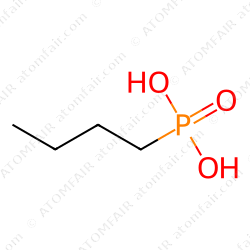
Butylphosphonic Acid (CAS No. 3321-64-0) is a high-purity organophosphorus compound with the molecular formula C4H11O3P, widely utilized in organic synthesis, coordination chemistry, and materials science. This versatile reagent features a phosphonic acid functional group bonded to a butyl chain, offering unique reactivity for metal chelation, surface modification, and catalysis. Our product is rigorously tested to ensure exceptional quality, with batch-specific analytical data (including 1H NMR, 31P NMR, and HPLC) available upon request. Supplied as a white crystalline solid or colorless solution (custom concentrations available), it’s packaged under inert atmosphere to guarantee stability. Ideal for:
- Ligand design for transition metal complexes
- Self-assembled monolayer (SAM) formation on metal oxides
- Modification of nanoparticles and catalytic surfaces
- Intermediate for flame retardants and specialty polymers
Storage recommendation: Maintain under nitrogen at 2-8°C in tightly sealed containers. Hazard classification: Corrosive (GHS05).
Properties
- CAS Number: 3321-64-0
- Complexity: 95.5
- IUPAC Name: butylphosphonic acid
- InChI: InChI=1S/C4H11O3P/c1-2-3-4-8(5,6)7/h2-4H2,1H3,(H2,5,6,7)
- InChI Key: UOKRBSXOBUKDGE-UHFFFAOYSA-N
- Exact Mass: 138.04458121
- Molecular Formula: C4H11O3P
- Molecular Weight: 138.10
- SMILES: CCCCP(=O)(O)O
- Topological: 57.5
- Monoisotopic Mass: 138.04458121
- Synonyms: Butylphosphonic acid, 1-Butanephosphonic acid, BUTYLPHOSPHONATE, n-butyl phosphonic acid, NSC-38367, CHEBI:41384, PHOSPHONIC ACID, P-BUTYL-, 679-394-7, 3321-64-0, 1-BUTYLPHOSPHONIC ACID, n-Butylphosphonic acid, Phosphonic acid, butyl-, HKC30FCB7P, Butylphosphonicacid, MFCD00012295, NSC 38367, Butylphosphonic acid #, UNII-HKC30FCB7P, SCHEMBL59054, SCHEMBL103934, SCHEMBL103935, SCHEMBL6709493, Butylphosphonic Acid, >/=98%, SCHEMBL11203643, SCHEMBL21385310, DTXSID30186861, NSC38367, AKOS028108505, DB03999, DB-048361, B6044, CS-0451169, NS00071900, D89182, Q27094855
Application
Butylphosphonic Acid serves as an effective coupling agent for surface functionalization of metal oxides like indium tin oxide (ITO) in electronic devices. Researchers employ it as a precursor for phosphonate-based metal-organic frameworks (MOFs) with tunable porosity. In catalysis, it acts as a ligand modifier to enhance selectivity in cross-coupling reactions. The compound also finds use in creating corrosion-resistant coatings through strong chemisorption on oxidized metal surfaces.
Safety and Hazards
GHS Hazard Statements
- H314 (100%): Causes severe skin burns and eye damage [Danger Skin corrosion/irritation]
Precautionary Statements
- P260, P264, P280, P301+P330+P331, P302+P361+P354, P304+P340, P305+P354+P338, P316, P321, P363, P405, and P501
Hazard Classes and Categories
- Skin Corr. 1B (100%)
If you are interested or have any questions, please contact us at support@atomfair.com
Disclaimer: Sold exclusively for laboratory research. Prohibited for commercial use, diagnostics, or human/animal applications. Buyers assume all compliance liability.
Reviews
There are no reviews yet.