Description
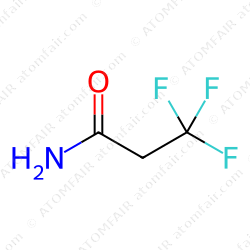
3,3,3-Trifluoropropanamide (CAS No. 460-75-3) is a high-purity fluorinated organic compound with the molecular formula C3H4F3NO. This specialty chemical is characterized by its trifluoromethyl group, which imparts unique reactivity and stability, making it a valuable intermediate in pharmaceutical, agrochemical, and materials science research. It is supplied as a white to off-white crystalline solid with a purity of ≥98% (GC), ensuring consistency for synthetic applications. The compound is rigorously tested for quality, including NMR and HPLC analysis, to meet the stringent requirements of researchers and industrial scientists. Proper storage conditions (2-8°C, dry, inert atmosphere) are recommended to maintain its integrity.
Properties
- CAS Number: 460-75-3
- Complexity: 97.2
- IUPAC Name: 3,3,3-trifluoropropanamide
- InChI: InChI=1S/C3H4F3NO/c4-3(5,6)1-2(7)8/h1H2,(H2,7,8)
- InChI Key: MZBSJLAGBUNNLH-UHFFFAOYSA-N
- Exact Mass: 127.02449824
- Molecular Formula: C3H4F3NO
- Molecular Weight: 127.07
- SMILES: C(C(=O)N)C(F)(F)F
- Topological: 43.1
- Monoisotopic Mass: 127.02449824
- Synonyms: 3,3,3-trifluoropropanamide, 460-75-3, DTXSID90616356, DTXCID30567111, 843-210-5, MFCD11646085, trifluoromethylacetamide, SCHEMBL211941, SCHEMBL288174, SCHEMBL1030134, MZBSJLAGBUNNLH-UHFFFAOYSA-N, ZGVCXYVWQBQTDQ-UHFFFAOYSA-N, AKOS005263771, BS-12879, DB-293804, CS-0452664, EN300-50542, C15826, AB01003809-01, Z394696754
Application
3,3,3-Trifluoropropanamide serves as a versatile building block in organic synthesis, particularly for introducing trifluoromethyl groups into target molecules. It is employed in the development of fluorinated pharmaceuticals and agrochemicals due to its ability to enhance metabolic stability and bioavailability. Researchers also utilize it in material science for designing advanced polymers with tailored properties.
Safety and Hazards
GHS Hazard Statements
- H302 (100%): Harmful if swallowed [Warning Acute toxicity, oral]
- H315 (100%): Causes skin irritation [Warning Skin corrosion/irritation]
- H319 (100%): Causes serious eye irritation [Warning Serious eye damage/eye irritation]
- H335 (100%): May cause respiratory irritation [Warning Specific target organ toxicity, single exposure; Respiratory tract irritation]
Precautionary Statements
- P261, P264, P264+P265, P270, P271, P280, P301+P317, P302+P352, P304+P340, P305+P351+P338, P319, P321, P330, P332+P317, P337+P317, P362+P364, P403+P233, P405, and P501
Hazard Classes and Categories
- Acute Tox. 4 (100%)
- Skin Irrit. 2 (100%)
- Eye Irrit. 2A (100%)
- STOT SE 3 (100%)
If you are interested or have any questions, please contact us at support@atomfair.com
Disclaimer: Sold exclusively for laboratory research. Prohibited for commercial use, diagnostics, or human/animal applications. Buyers assume all compliance liability.
Reviews
There are no reviews yet.