Description
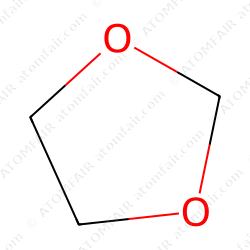
1,3-Dioxolane (CAS No. 646-06-0) is a high-purity cyclic acetal with the molecular formula C3H6O2, widely utilized in organic synthesis and industrial applications. This colorless, volatile liquid exhibits excellent solvency properties and is commonly employed as a solvent, stabilizer, or intermediate in pharmaceuticals, agrochemicals, and polymer chemistry. Its cyclic structure, featuring two oxygen atoms in a five-membered ring, enhances reactivity in polymerization and cross-linking reactions. 1,3-Dioxolane is rigorously tested for quality, ensuring low water content, high chemical stability, and minimal impurities, making it ideal for sensitive reactions and electrochemical applications. Available in various packaging options, including amber glass bottles and bulk drums, to suit laboratory and industrial-scale needs.
Properties
- CAS Number: 646-06-0
- Complexity: 24.1
- IUPAC Name: 1,3-dioxolane
- InChI: InChI=1S/C3H6O2/c1-2-5-3-4-1/h1-3H2
- InChI Key: WNXJIVFYUVYPPR-UHFFFAOYSA-N
- LogP: log Kow = -0.37
- Exact Mass: 74.036779430
- Molecular Formula: C3H6O2
- Molecular Weight: 74.08
- SMILES: C1COCO1
- Topological: 18.5
- Monoisotopic Mass: 74.036779430
- Physical Description: Dioxolane appears as a clear colorless liquid. Slightly denser than water. Vapors heavier than air.
- Color/Form: Water-white liquid
- Boiling Point: 78 °C
- Melting Point: -95 °C
- Flash Point: 35 °F
- Solubility: Soluble in ethanol, ether, acetone
- Density: 1.0600 at 20 °C/4 °C
- Vapor Density: 2.6
- Vapor Pressure: 79.0 [mmHg]
- Henry’s Law Constant: Henry’s Law constant = 2.4X10⁻⁵ atm-cu m/mole at 25 °C
- Refractive Index: Index of refraction: 1.3974 at 20 °C/D
- Synonyms: 1,3-DIOXOLANE, DIOXOLANE, Formal glycol, Dioxolan, Glycol formal, Glycol methylene ether, Dioxolan [Czech], Dioxolane, 1,3-, 5-Crown-2, CCRIS 4912, HSDB 5737, UNII-Y57RBG19JL, EINECS 211-463-5, DTXSID4027284, CHEBI:87597, ELCOTAL DX, DTXCID107284, 1,3-DIOXOLANE [HSDB], EC 211-463-5, 1,3Dioxolan, 1,4-dioxolane, 1,3Dioxacyclopentane, dihydro-1,3-dioxole, 1,3Dioxole, dihydro, DIOXOLANE [INCI], CHEBI:39430, inchi=1/c3h6o2/c1-2-5-3-4-1/h1-3h, wnxjivfyuvyppr-uhfffaoysa-n, 646-06-0, Glycolformal, 1,3-Dioxacyclopentane, 1,3-Dioxolan, 1,3-Dioxolane, Stabilized, Ethylene glycol formal, 1,3-Dioxole, dihydro-, 1,3-Dioxlane, 1,3-Dioxolane (stabilized with BHT), Y57RBG19JL, 1,3-dioxalane, MFCD00003207, UN1166, Formaldehyde ethylene acetal, Ethylene glycol methylene ether, 1,3 dioxolane, [1,3]dioxolane, [1,3]-dioxolane, Ethylene glycol, formal, SCHEMBL3387, SCHEMBL23012, SCHEMBL76137, SCHEMBL76442, SCHEMBL452393, SCHEMBL2640146, SCHEMBL5144293, CHEMBL3187281, SCHEMBL16861374, 1,3-Dioxolane, >=99.5%, Tox21_300693, AKOS015856096, FD54839, NCGC00248143-01, NCGC00254601-01, CAS-646-06-0, Dioxolane [UN1166] [Flammable liquid], D0861, D5539, NS00004542, 1,3-Dioxolane 100 microg/mL in Acetonitrile, 1,3-Dioxolane;Ethylene glycol methylene ether, D89731, A834826, Q2234483, 1,3-Dioxlane, 99.5%, contains ~75 ppm BHT as stabilizer, 1,3-Dioxacyclopentane,Anhydrous, Contains ~ 75 ppm BHT as inhibitor., 1,3-Dioxolane, anhydrous, contains ~75 ppm BHT as inhibitor, 99.8%, 1,3-Dioxolane, ReagentPlus(R), contains ~75 ppm BHT as inhibitor, 99%, 1,3-Dioxlane, 99.8%,with molecular sieves, stabilized with BHT, Water</=50 ppm (by K.F.), MkSeal, 25067-64-5
Application
1,3-Dioxolane serves as a versatile solvent in Grignard reactions, polymerization, and electrolyte formulations for lithium-ion batteries due to its high dielectric constant. It acts as a protective group for carbonyl compounds in organic synthesis and is a key intermediate in producing pharmaceuticals and fragrances. Additionally, its stability under acidic conditions makes it valuable in resin and adhesive manufacturing.
Safety and Hazards
GHS Hazard Statements
- H318: Causes serious eye damage [Danger Serious eye damage/eye irritation]
Precautionary Statements
- P264+P265, P280, P305+P354+P338, and P317
Hazard Classes and Categories
- Flammable liquids – Category 2
- Acute toxicity – Category 5
- Skin corrosion/irritation – Category 3
- Serious eye damage/eye irritation – Category 2A
- Germ cell mutagenicity – Category 2
- Reproductive toxicity – Category 2
If you are interested or have any questions, please contact us at support@atomfair.com
Disclaimer: Sold exclusively for laboratory research. Prohibited for commercial use, diagnostics, or human/animal applications. Buyers assume all compliance liability.
Reviews
There are no reviews yet.