
Three-Electrode Coin Cells serve as an invaluable tool for assessing the electrochemical properties of electrode sheets and battery layers, particularly in terms of electrode potential response and impedance contribution. This article focuses on using lithium titanate (Li₄Ti₅O₁₂) as the reference electrode, evaluating impedance characteristics across different State of Charge (DOD) ranges, and comparing three-electrode coin cell data with symmetric cell and full-cell data to analyze the impedance contribution of positive and negative electrode sheets to full cells at various DOD levels.
Fabrication Process of Three-Electrode Coin Cells
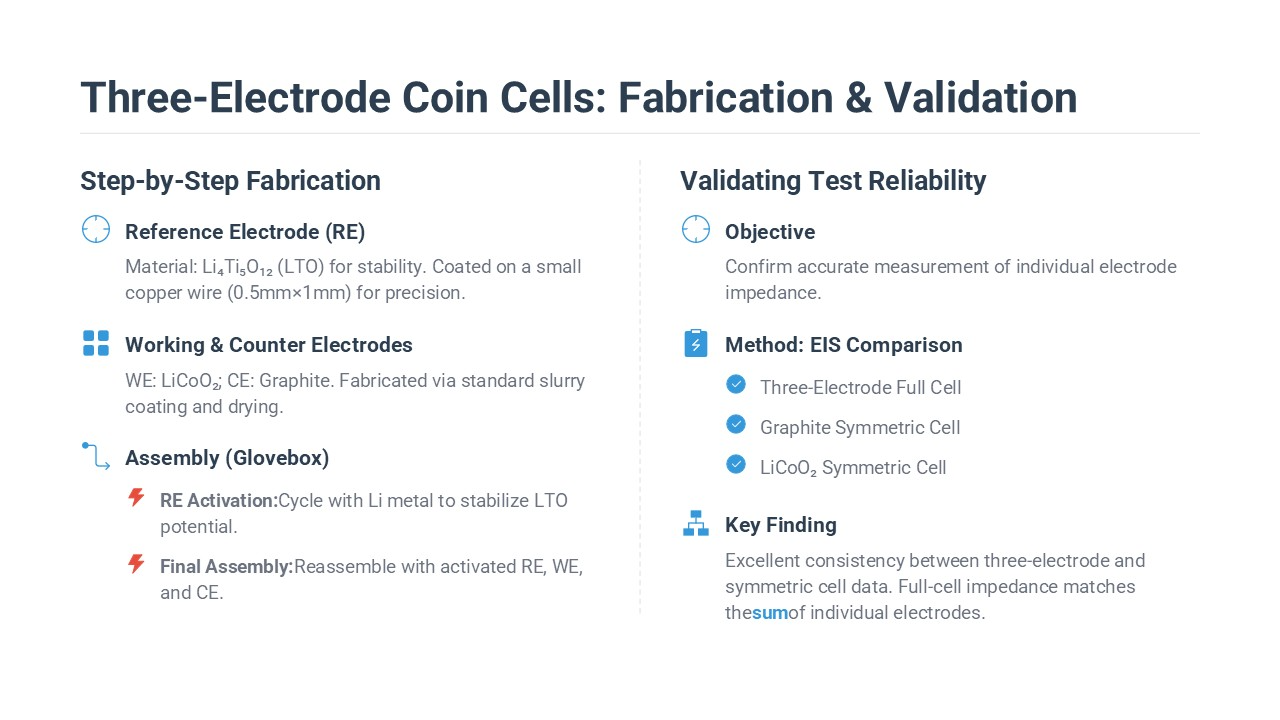
Building on previous research, Li₄Ti₅O₁₂ was selected as the reference electrode. A thin layer of Li₄Ti₅O₁₂ slurry was coated onto a 0.5mm×1mm copper wire—smaller reference electrodes offer higher precision. Compared to metallic lithium, Li₄Ti₅O₁₂ enhances the potential stability of the reference electrode during Electrochemical Impedance Spectroscopy (EIS) testing.
Positive (LiCoO₂) and negative (graphite) electrode sheets were fabricated through a series of processes, then cut to size for assembling CR2032-type coin cells. All assembly steps were conducted in an argon-filled glovebox to prevent contamination.
The first critical step was activating the reference electrode by intercalating an appropriate amount of lithium ions into Li₄Ti₅O₁₂ to maintain a stable potential. During this activation phase, both the working electrode and counter electrode were made of metallic lithium. To avoid breaking the copper wire of the reference electrode during assembly, the wire was pre-bent to match the internal shape of the coin cell case. Additionally, separators were placed above and below the reference electrode to prevent short circuits with the working or counter electrode.
For lithium intercalation, the reference electrode acted as the cathode and the counter electrode as the anode. The cell was cycled once at a C/16 rate, then charged to 50% of its capacity—this process ensured Li₄Ti₅O₁₂ reached a stable voltage plateau. After intercalation, the coin cell was disassembled, the activated reference electrode was removed, and a new three-electrode coin cell was reassembled using LiCoO₂ as the positive electrode and graphite as the negative electrode. For more insights into optimizing three-electrode fabrication, refer to related studies on addressing “inaccuracy issues” in three-electrode systems and improvement strategies.
Reliability Validation of Three-Electrode Coin Cell Tests
After fabricating the three-electrode coin cells, their reliability was validated by comparing EIS data from three cell types:
- Three-electrode coin cells with graphite negative electrodes and LiCoO₂ positive electrodes;
- Symmetric cells with graphite as both electrodes;
- Symmetric cells with LiCoO₂ as both electrodes.
All cells included a Li₄Ti₅O₁₂ reference electrode.
Analysis of the EIS results revealed that the impedance of the positive and negative electrodes in the three-electrode full cell (marked in red) showed excellent consistency with the symmetric cell data. In symmetric cells, green data points represented the impedance between the electrode and the reference electrode, blue lines represented total impedance, and blue dashed lines represented half of the total impedance. This alignment confirmed the high accuracy of the three-electrode full cell in measuring individual electrode impedance.
Furthermore, the full-cell impedance closely matched the sum of the positive and negative electrode impedances in the three-electrode cell, as well as the impedance of symmetric cells. Minor discrepancies at high frequencies were attributed to slight variations in coin cell assembly, which is a common and well-documented challenge in electrochemical cell fabrication (consistent with observations in Journal of the Electrochemical Society studies).
Analysis of Positive and Negative Electrode Impedance Across Different DOD Ranges
EIS data for positive, negative, and full-cell impedance across different DOD levels revealed distinct impedance components for each electrode:
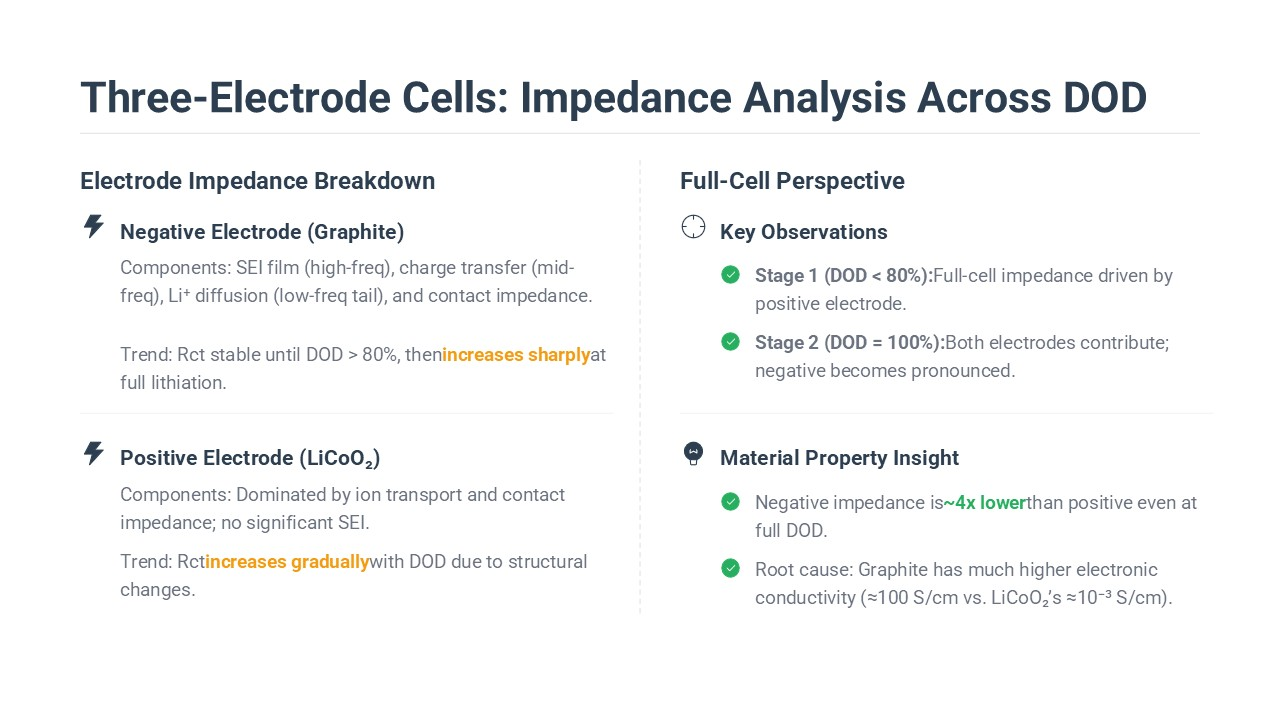
For the negative electrode (graphite), impedance consists of four key parts:
- A high-frequency semicircle corresponding to Solid Electrolyte Interphase (SEI) film impedance;
- A mid-frequency semicircle representing charge transfer impedance;
- A low-frequency tail associated with solid-phase lithium diffusion impedance;
- The intercept with the real impedance axis (ReZ) corresponding to structural and contact impedance.
For the positive electrode (LiCoO₂), impedance analysis excludes SEI-related components (as LiCoO₂ does not form a stable SEI film under typical operating conditions). Instead, ion transport impedance and contact impedance are the primary contributors to overall impedance.
Key trends observed from the data include:
- For the negative electrode: When DOD < 80%, charge transfer impedance remains relatively low. At DOD = 100% (full lithiation), charge transfer impedance increases sharply—this is because lithium ion intercalation becomes significantly more difficult in fully lithiated graphite, where available intercalation sites are scarce.
- For the positive electrode: Charge transfer impedance increases gradually as DOD rises. This is attributed to the progressive structural changes in LiCoO₂ during lithium deintercalation (e.g., lattice parameter variations), which hinder ion and electron transport.
From the full-cell perspective, EIS behavior can be divided into two stages:
- DOD < 80%: The increase in charge transfer impedance is primarily driven by the positive electrode. At lower DOD levels, the negative electrode’s high conductivity and efficient lithium intercalation keep its impedance minimal.
- DOD = 100%: Both positive and negative electrodes contribute to the rise in charge transfer impedance, with the negative electrode’s contribution being more pronounced. However, even at full DOD, the negative electrode’s overall impedance is approximately 4 times lower than the positive electrode’s—this is due to graphite’s higher electronic conductivity (≈100 S/cm) compared to LiCoO₂ (≈10⁻³ S/cm), a fundamental material property that impacts battery performance.