
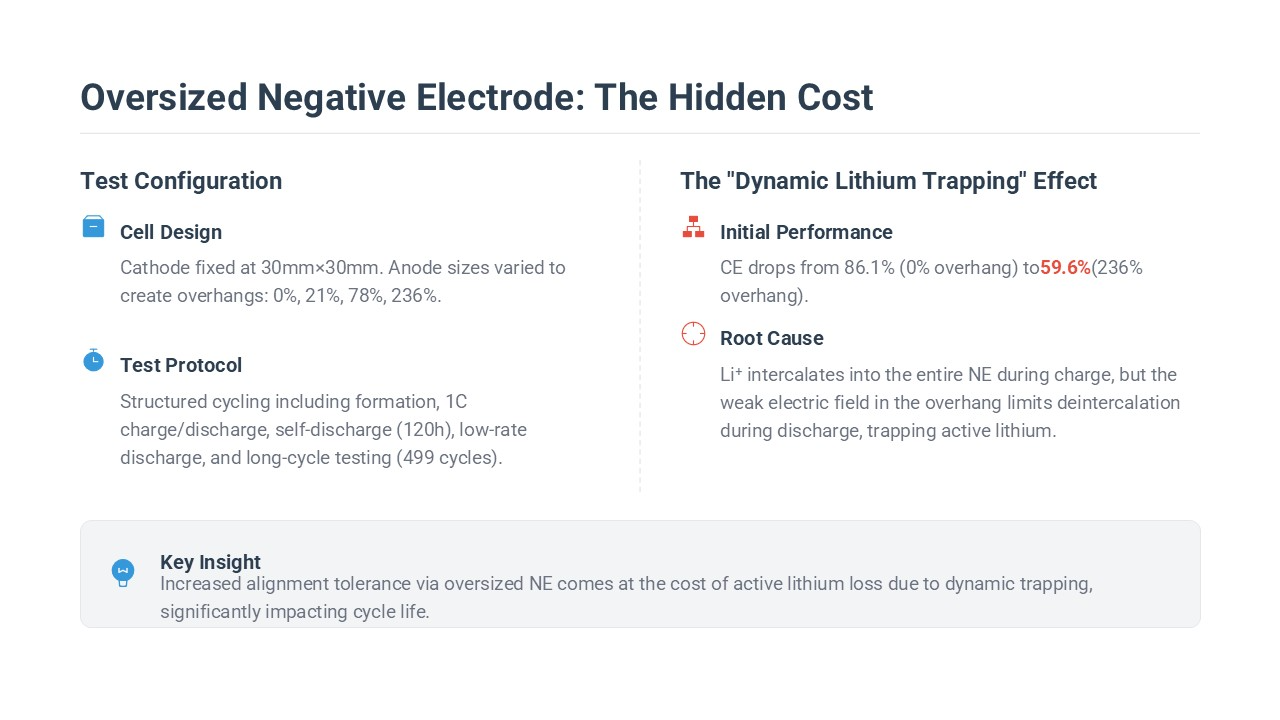
Oversized Negative Electrode is a critical design factor in lithium-ion batteries, as the alignment accuracy between positive and negative electrodes directly influences electrochemical performance. While an oversized negative electrode increases tolerance for electrode alignment, it introduces unexpected challenges during charge-discharge cycles. This article systematically explores the effects of an oversized negative electrode on specific capacity loss using electrochemical and analytical methods, revealing that excessive overhang traps active lithium dynamically, degrading battery performance.
Cell Design and Test Configuration
Four types of pouch cells with varying negative electrode overhangs were fabricated. The positive electrode was fixed at 30 mm × 30 mm (900 mm²), while the negative electrode sizes were adjusted to create different area ratios: 30 mm × 30 mm (0% overhang), 33 mm × 33 mm (21% overhang), 40 mm × 40 mm (78% overhang), and 55 mm × 55 mm (236% overhang).
All cells were cycled between 4.2 V and 3.0 V following a structured protocol:
Formation Cycles (1–5):
5 constant-current (CC) cycles optimized for Solid Electrolyte Interphase (SEI) formation (Cycle 1: 0.05C charge / 0.1C discharge; Cycles 2–5: 0.1C charge / 0.1C discharge).
Cycle 6:
1C constant-current/constant-voltage (CC/CV) charge (cutoff at 0.05C) followed by 1C CC discharge.
Cycle 7:
Self-discharge (SD) test (120-hour rest) after 1C CC/CV charge, followed by 1C CC discharge.
Cycles 8–19:
Routine 1C CC/CV charge / 1C CC discharge.
Cycle 20:
1C CC/CV charge followed by low-rate (0.05C) constant-voltage discharge (dcv) to eliminate kinetic limitations.
Cycles 21+:
Continuous 1C CC/CV charge / 1C CC discharge.
For long-cycle testing, four extended protocols were implemented, incorporating 5 formation cycles and 494 CC/CV charge-discharge cycles (2C rate). Key variations included periodic SD tests (120-hour rest after selected charges), dcv steps (after selected discharges), or combinations of both, with rest periods (50 minutes) at cycles 20, 120, 220, 320, and 420 to monitor stability.
Impact of Oversized Negative Electrode on Specific Capacity
Initial cycle Coulombic Efficiency (CE) decreased significantly with increasing negative electrode overhang. The cell with no overhang (0%) achieved the highest CE of 86.10±0.03%, while cells with 21%, 78%, and 236% overhangs showed declining values: 84.22±0.02%, 77.00±0.01%, and 59.6±0.7%, respectively.
This trend persisted through subsequent cycles: discharge capacity and capacity retention worsened as overhang increased. The primary cause is the “dynamic lithium trapping” in the overhang region—the portion of the negative electrode not overlapping with the positive electrode. During charging, lithium ions intercalate into the entire negative electrode, but during discharge, the weak electric field in the overhang limits lithium deintercalation, leaving active lithium trapped temporarily or permanently.
Impact of Oversized Negative Electrode on Self-Discharge
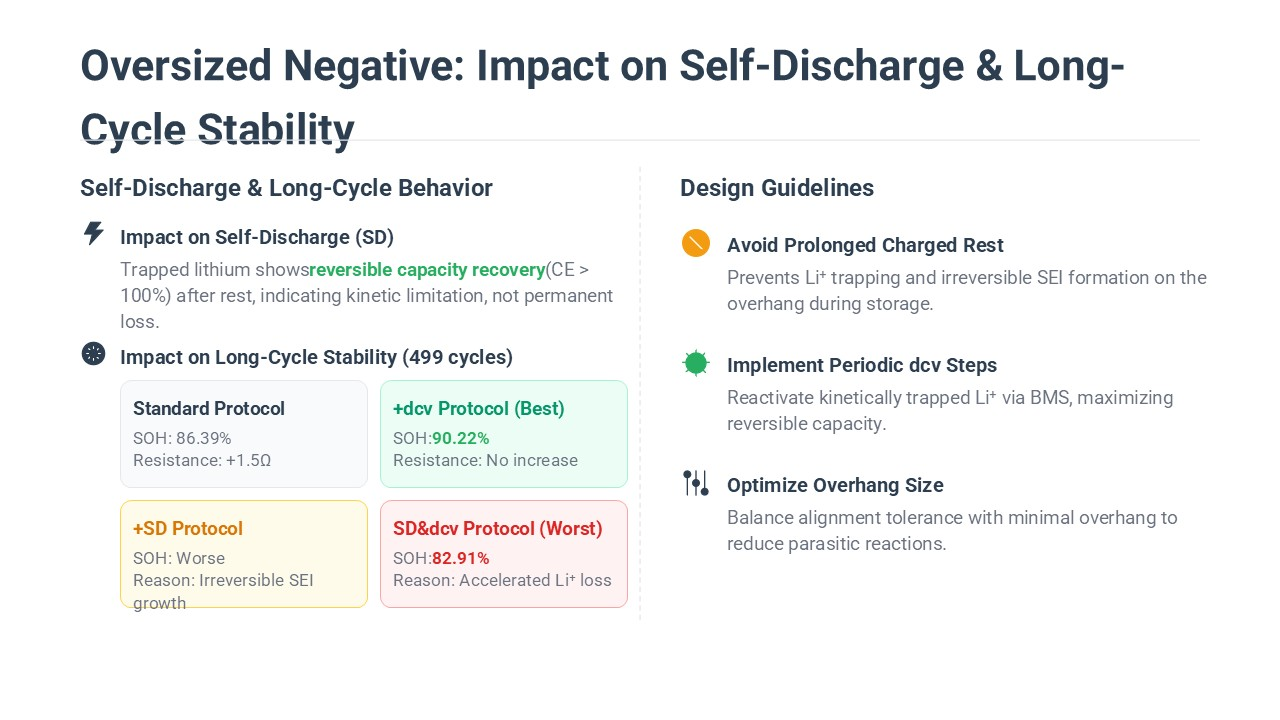
After the SD test (Cycle 7), cells with oversized negative electrodes exhibited significant capacity recovery in subsequent cycles, with CE exceeding 100% (discharge capacity > charge capacity). This indicates that kinetically trapped lithium from previous cycles was reactivated.
Capacity recovery values between Cycles 7 and 19 were 3.15±0.07 mAh∙g⁻¹ (21% overhang), 2.8±0.4 mAh∙g⁻¹ (78% overhang), and 4.9±0.5 mAh∙g⁻¹ (236% overhang). The dcv step in Cycle 20 further enhanced recovery by forcing complete discharge, confirming that trapped lithium in the overhang is largely reversible but kinetically limited.
The mechanism behind this behavior involves lithium redistribution during prolonged rest (SD test). Lithium ions diffuse uniformly across the entire negative electrode, including the overhang. During discharge, the strong electric field in the overlapping region drives efficient deintercalation, while the overhang (weak electric field) retains lithium. Subsequent cycles allow gradual lithium migration from the overhang to the active region, restoring capacity.
Impact of Oversized Negative Electrode on Long-Cycle Stability
Long-cycle tests (499 cycles) revealed distinct performance trends based on the protocol:
Standard Protocol (no SD/dcv):
After 499 cycles, the cell retained 86.39% State of Health (SOH) with a specific discharge capacity of 112.3±0.3 mAh∙g⁻¹ (initial capacity: 130.0±0.1 mAh∙g⁻¹) and an internal resistance increase of ~1.5 Ω.
+dcv Protocol:
Periodic dcv steps improved SOH to 90.22% with no significant resistance increase. The dcv step effectively reactivated trapped lithium, offsetting capacity loss from overhang accumulation.
+SD Protocol:
Periodic SD tests degraded performance, resulting in lower capacity and higher resistance. Prolonged charging-induced rest promoted irreversible lithium consumption in SEI formation on the overhang, reducing available lithium and increasing impedance.
SD&dcv Protocol:
Combining SD and dcv steps yielded the worst results (SOH: 82.91%), as frequent lithium migration between the overhang and active region accelerated SEI growth, consuming irreversible lithium.
Key Takeaways for Battery Design
An Oversized Negative Electrode offers alignment flexibility but poses performance tradeoffs. To mitigate risks:
- Avoid prolonged charging-induced rest (e.g., storage in fully charged states), as it exacerbates lithium trapping and irreversible SEI formation in the overhang.
- Implement periodic low-rate dcv steps to reactivate trapped lithium, maximizing reversible capacity.
- Optimize overhang size: balance alignment tolerance with minimal overhang to reduce lithium trapping and SEI growth.