
Introduction to Lithium Dendrite Formation
Lithium dendrite formation is one of the most persistent challenges in lithium-ion battery research, posing significant risks to battery safety and durability. These needle-like or mossy lithium deposits grow on the battery’s negative electrode (anode) during charging cycles, and their development involves a complex interplay of electrochemistry, crystallography, thermodynamics, and kinetics. In some cases, lithium dendrites that remain in contact with the anode can be reused during subsequent discharge, but those that lose contact become “dead lithium”—inactive material that reduces battery capacity over time. To address this issue, understanding the root causes of lithium dendrite formation is essential for advancing battery technology and ensuring reliable energy storage solutions.
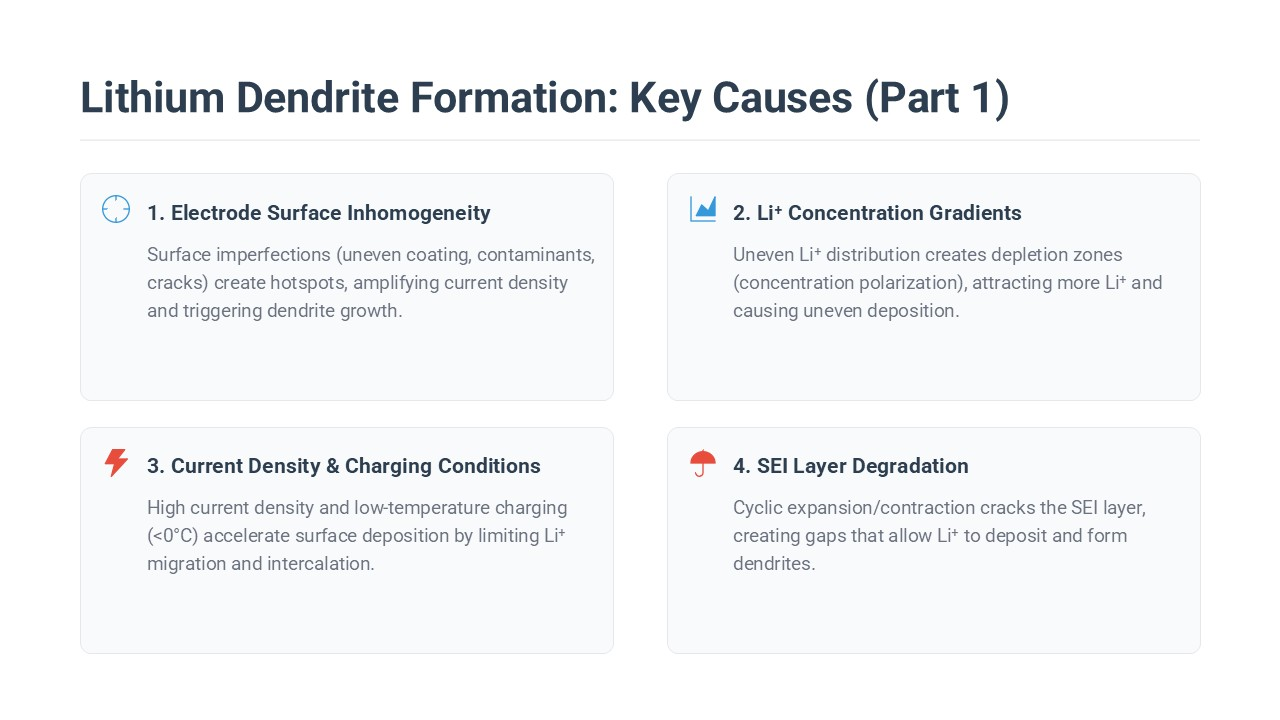
1. Electrode Surface Inhomogeneity: A Primary Trigger
Electrode surface inhomogeneity is a major contributor to lithium dendrite formation. Imperfections on the anode’s surface create localized areas where lithium ions (Li⁺) preferentially deposit, initiating dendrite growth. Common sources of inhomogeneity include:
- Uneven coating during electrode manufacturing, which leads to variations in thickness across the anode.
- Contaminants mixed with the anode’s active material (e.g., graphite), which disrupt uniform Li⁺ deposition.
- Microscopic defects such as cracks or pores on the anode surface, which act as “seeds” for dendrite nucleation.
- Gas evolution within the battery (a byproduct of electrolyte decomposition), which creates irregularities on the electrode surface and disturbs Li⁺ distribution.
Even minor surface irregularities can amplify localized current density, making these regions hotspots for dendrite growth.
2. Lithium Ion Concentration Gradients and Distribution
During battery charging, lithium ions migrate from the positive electrode (cathode) through the electrolyte to the anode, where they are deposited as metallic lithium. However, uneven Li⁺ concentration in the electrolyte creates gradients that disrupt uniform deposition. When current density is high, for example, Li⁺ is consumed at the anode surface faster than it can be replenished by the electrolyte. This leads to a sharp drop in Li⁺ concentration near the anode (a phenomenon called “concentration polarization”) and the formation of localized space charge regions. These regions attract more Li⁺, causing uneven deposition that evolves into dendrites. Over time, this gradient exacerbates dendrite growth and reduces the battery’s ability to store and deliver energy efficiently.
3. Current Density and Charging Conditions
High current density and extreme charging conditions are key accelerators of lithium dendrite formation. Every battery has a threshold current density beyond which Li⁺ cannot deposit uniformly on the anode. When this threshold is exceeded, Li⁺ accumulates in localized areas instead of integrating into the anode’s crystal structure (e.g., intercalating into graphite), leading to dendrite nucleation. Post-charging analysis supports this: monitoring the open-circuit voltage (OCV) of batteries after fast charging reveals sharp peaks in the OCV curve, indicating unstable Li⁺ deposition rather than steady capacity retention.
Low-temperature charging (below 0°C) further worsens the problem. Cold conditions slow the migration of Li⁺ through the electrolyte and reduce their diffusion rate into the anode’s active material. As a result, Li⁺ accumulates on the anode surface instead of being absorbed, increasing the likelihood of dendrite formation. This is a critical concern for electric vehicles and portable electronics used in cold climates, where low-temperature charging is common.
4. SEI Layer Degradation and Reconstruction
The solid electrolyte interphase (SEI) layer—a thin, protective film that forms on the anode surface during the first charging cycle—plays a vital role in preventing lithium dendrite growth. A stable SEI layer blocks direct contact between the anode and electrolyte, reduces electrolyte decomposition, and ensures uniform Li⁺ transport. However, the SEI layer is not permanent: during repeated charging-discharging cycles, mechanical stress (from anode expansion and contraction) causes the SEI layer to crack or peel. When this happens, fresh anode material is exposed to the electrolyte, triggering new SEI formation. This continuous destruction and reconstruction process creates gaps in the SEI layer, allowing Li⁺ to deposit through cracks and form dendrites. Additionally, the quality and composition of the SEI layer (e.g., high levels of lithium carbonate, Li₂CO₃) can influence dendrite growth rate—some SEI components are more prone to cracking, increasing dendrite risk.
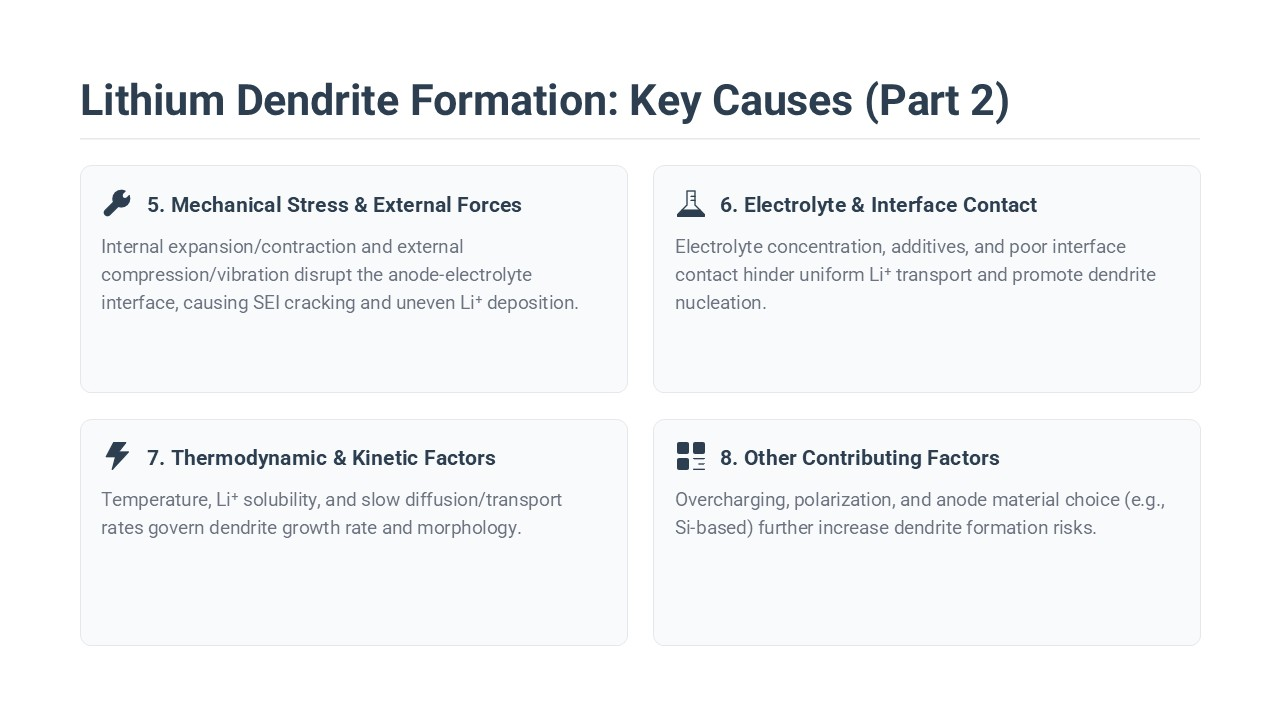
5. Mechanical Stress and External Forces
Mechanical stress within the battery and external forces also impact lithium dendrite formation. Battery operation involves repeated expansion and contraction of the anode (e.g., graphite anodes expand by ~10% when fully lithiated). This cyclic volume change creates uneven stress distribution across the anode, leading to localized stress concentrations. These regions are more likely to experience SEI cracking and uneven Li⁺ deposition, fostering dendrite growth.
External forces, such as physical compression or vibration (common in automotive applications), can further disrupt the anode-electrolyte interface. For example, compression may deform the anode, altering current distribution and creating dendrite hotspots. Understanding these mechanical effects is crucial for designing robust batteries that withstand real-world use.
6. Electrolyte Composition and Interface Contact
The electrolyte’s composition and its contact with the anode directly influence lithium dendrite formation. Key factors include:
- Li⁺ concentration: Low Li⁺ concentration in the electrolyte exacerbates concentration gradients, increasing dendrite risk. Conversely, excessively high Li⁺ concentration can increase electrolyte viscosity, slowing ion transport.
- Electrolyte additives: While some additives (e.g., vinylene carbonate) stabilize the SEI layer, others (e.g., excess Li₂CO₃) can disrupt Li⁺ deposition and promote dendrites.
- Interface contact: Poor contact between the anode and electrolyte (e.g., due to electrode warping or electrolyte dry-out) creates regions of low ion conductivity. Li⁺ accumulates in well-contacted areas, leading to dendrite growth.
Studies (e.g., research published in Advanced Energy Materials) have shown that batteries with uniform electrolyte contact and optimized additive packages exhibit significantly less dendrite formation compared to those with suboptimal electrolyte conditions.
7. Thermodynamic and Kinetic Factors
Thermodynamic and kinetic properties govern the rate and morphology of lithium dendrite growth. Thermodynamically, temperature affects the stability of the SEI layer and the solubility of Li⁺ in the electrolyte. Higher temperatures can improve Li⁺ diffusion but may accelerate electrolyte decomposition, while lower temperatures (as discussed earlier) slow ion transport and promote surface deposition.
Kinetically, the rate of Li⁺ diffusion into the anode (solid-state diffusion) and the rate of Li⁺ deposition on the anode surface are critical. If Li⁺ diffuses into the anode too slowly (e.g., in low-quality graphite), it accumulates on the surface, forming dendrites. Similarly, slow Li⁺ transport through the electrolyte (due to high viscosity or low ion conductivity) disrupts uniform deposition. Balancing these kinetic factors is essential for suppressing dendrite growth and ensuring efficient Li⁺ intercalation.
8. Other Contributing Factors
Several additional factors can influence lithium dendrite formation, including overcharging, polarization effects, and anode material selection. Overcharging occurs when the battery is charged beyond its rated capacity; in this case, the anode cannot absorb all incoming Li⁺, so excess Li⁺ deposits as metallic lithium on the anode surface, forming dendrites. Polarization (a voltage difference between the battery’s open-circuit voltage and its operating voltage) also plays a role: high polarization increases localized current density, creating conditions favorable for dendrite growth.
Anode material choice is another critical factor. Graphite is the most common anode material in commercial lithium-ion batteries, but its limited Li⁺ intercalation capacity (compared to lithium metal) can lead to surface deposition when overcharged. Emerging materials like silicon-based anodes offer higher capacity but undergo larger volume changes, increasing mechanical stress and SEI degradation—factors that indirectly promote dendrite formation.