
In the world of pouch cell development and quality control, Constant Gap and Constant Pressure fixtures are two fundamental tools. However, they serve distinct purposes. Selecting the appropriate fixture is critical for obtaining accurate, relevant data. This article clarifies the core applications of each, guiding you to make the right choice for your specific testing goals.
Core Concept: A Tale of Two Control Parameters
First, a quick review of the fundamental operating principles:
- The Constant Gap Fixture (The Dimensional Enforcer): This fixture maintains a rigid, unchanging distance between its two plates. It simulates a scenario where the cell is confined in a space with zero room for expansion. As the cell swells during cycling or abuse, the internal pressure rises dramatically.
- The Constant Pressure Fixture (The Force Balancer): This fixture applies and maintains a precise, unchanging force on the cell by dynamically adjusting the distance between the plates.
Understanding this distinction is key to identifying their ideal use cases.
Scenario 1: Employ the Constant Gap Fixture – When Measuring Intrinsic Cell Properties
The primary role of a Constant Gap fixture is to quantify the cell’s inherent expansion behavior by converting it into a measurable force. It answers the question: “How much force does this cell generate under specific conditions?”
Typical Applications:
1. Expansion Force and Thickness Change Studies (R&D Core)
This is the most critical application for Constant Gap fixtures. Lithium-ion cells expand and contract due to electrode material volume changes during lithium intercalation/de-intercalation.
- Your Goal: Characterize the swelling behavior of a new electrode material or cell design.
- Why Constant Gap? By physically preventing expansion, all volumetric change is converted into pressure against the plates. A load sensor records a Pressure vs. Time/SOC (State of Charge) curve.
- Key Insights:
- Expansion Coefficients: Precisely quantify thickness change at different SOC levels.
- Material Stability: Identify abnormal pressure spikes indicating side reactions or phase transitions.
- SEI Formation: Monitor pressure changes during the first cycle (formation) to infer the stability of the Solid Electrolyte Interphase.
2. Safety Testing: Overcharge & Thermal Abuse (Failure Analysis)
Here, the Constant Gap fixture simulates a worst-case “no-escape” scenario.
- Your Goal: Evaluate cell behavior under abusive conditions like overcharging or heating to thermal runaway.
- Why Constant Gap? It replicates a tightly packed battery pack with no room for expansion. Internal gas generation and thermal expansion lead to a rapid, uncontrolled pressure and temperature rise, accelerating failure.
- Key Insights:
- Vent Pressure: Accurately measure the internal pressure at which the safety vent opens.
- Failure Severity: Assess the violence and dynamics of thermal runaway.
3. Process Quality Control (Thickness Sorting)
- Your Goal: Perform rapid pass/fail checks on cell thickness consistency on a production line.
- Why Constant Gap? It acts as a fixed “go/no-go” gauge. In-spec cells fit easily, while out-of-tolerance cells will not fit or generate an abnormally high initial pressure.
Constant Gap Summary: Use it when your question is about the cell’s intrinsic properties—what the cell itself does under constrained conditions.
Scenario 2: Employ the Constant Pressure Fixture – When Simulating Real-World Conditions
The primary role of a Constant Pressure fixture is to replicate the mechanical environment a cell experiences in actual use. It answers the question: “How will this cell perform in terms of lifetime and safety under realistic mechanical constraints?”
Typical Applications:
1. Simulating Module/Pack Conditions (Reliability & Life Cycling)
This is the most significant application and differentiator for Constant Pressure testing. In a real battery module, cells are compressed with a specific pre-load force for structural integrity and thermal management, but with some allowance for expansion.
- Your Goal: Predict cell performance and degradation over years of service within a pack.
- Why Constant Pressure? It replicates the designed stack pressure (e.g., 0.5 MPa per cell) during long-term cycling tests.
- Key Insights:
- Realistic Aging Data: Degradation patterns (capacity fade, impedance growth) under constant pressure are far more representative of real-world performance than tests in free-standing or constant gap conditions.
- Optimal Pack Design: Helps engineers determine the ideal clamping force range that minimizes degradation without causing mechanical damage.
2. External Crush/Abuse Testing (Realistic Safety Validation)
- Your Goal: Simulate a cell being crushed in a vehicle collision.
- Why Constant Pressure? Real-world crushing involves energy absorption and deformation of the surrounding structure. A Constant Pressure test applies a sustained force, more accurately simulating this scenario than an infinitely rigid constraint.
- Key Insights: The cell’s deformation, short-circuit, and thermal runaway behavior under a persistent load, informing safer pack structural design.
3. Interface Contact Resistance Studies (Electrical Performance)
- Your Goal: Optimize the pressure applied to cell tabs and busbars to minimize contact resistance.
- Why Constant Pressure? It allows you to precisely set and maintain a force while measuring the corresponding contact resistance, identifying the optimal pressure for electrical performance and mechanical integrity.
Constant Pressure Summary: Use it when your question is about the cell’s performance in the real world—how the cell behaves in application.
Conclusion: Your Decision Matrix
| Testing Objective | Recommended Fixture | Rationale |
|---|---|---|
| Measuring intrinsic swelling force, studying material volume change | Constant Gap | Directly converts volumetric change into measurable force, isolating the cell’s inherent properties. |
| Fundamental material R&D, failure mechanism analysis | Constant Gap | Provides a rigid, repeatable boundary condition for controlled experiments. |
| Simulating long-term cycle life within a battery module | Constant Pressure | Key Differentiator. Replicates the actual mechanical environment for realistic lifetime prediction. |
| Realistic crush/abuse safety validation | Constant Pressure | Simulates a sustained force load, as experienced in real-world incidents. |
| High-throughput thickness sorting in QC | Constant Gap | Functions as an efficient and simple pass/fail gauge. |
The Simple Rule of Thumb:
- To investigate the cell’s “nature” (How much does it swell?), use Constant Gap.
- To predict the cell’s “destiny” (How long will it last in the field?), use Constant Pressure.
Modern advanced test systems often integrate both capabilities into a single platform, allowing engineers to seamlessly switch between Constant Gap and Constant Pressure modes. This flexibility provides a comprehensive understanding of cell behavior, delivering the crucial data needed to develop safer, more durable, and high-performing energy storage solutions.
Recommended products
-
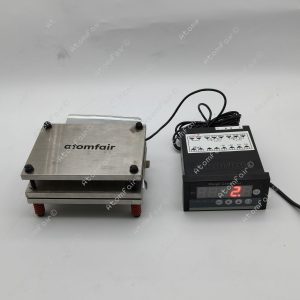
Atomfair Load Pressure Sensor and Adjustable Pressure Jig / Fixture Kit for Battery Pouch Cell
Price range: $299.95 through $529.95 -
Atomfair Pressure Sensor with Display
$219.95