Atomfair-APES 386 Automatic Polarized Light Experiment System
Product Overview
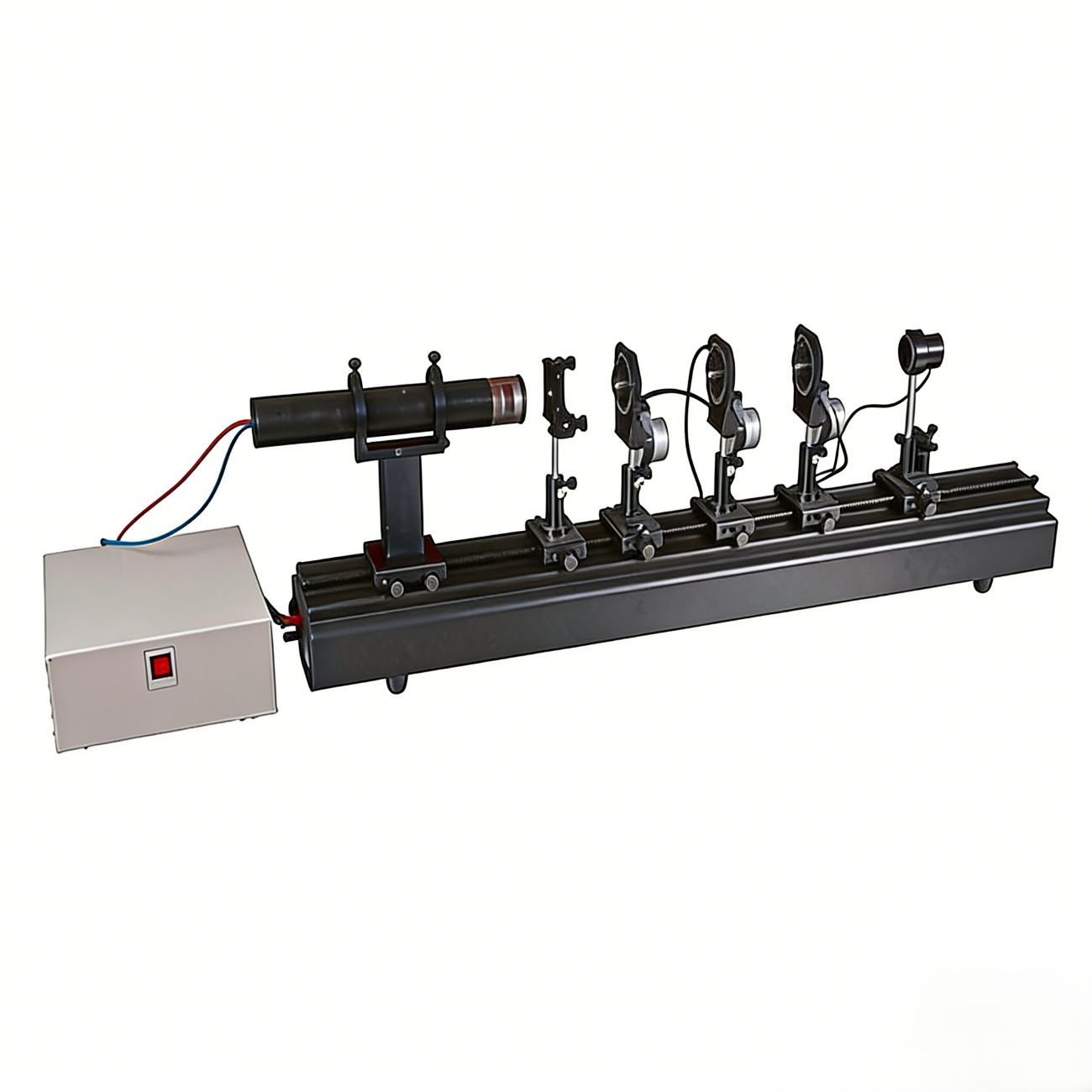
The Atomfair-APES 386 is a high-performance experimental system dedicated to interference, diffraction, and polarization-related research. It precisely manipulates the polarization state of light by utilizing motor-driven polarizers and waveplates—polarizers convert natural light into polarized light, while waveplates enable flexible adjustment of the polarization state. The system offers dual operational modes: automatic control and data processing via a computer, as well as manual operation and data recording. Complex experimental data is intuitively presented through a computer interface, making it an ideal choice for diverse educational and scientific research scenarios.
Notably, this product has been recognized for its exceptional quality and practicality. It was awarded the Second Prize in the 3rd National University Physics Experiment Teaching Instrument Competition and was a winning product of the World Bank Loan Higher Education Reform and Development Project.
Key Features
- Motor-driven polarizer rotation ensures stable operation and precise control.
- Equipped with professional software for experimental data fitting, enhancing data processing efficiency and accuracy.
- Supports full computer control of motor rotation, combining automated operation with manual adjustment to adapt to different experimental scenarios.
- Award-winning design with authoritative recognition, guaranteeing reliable performance and usability.
Experimental Capabilities
- Verify Malus’s Law through comparison between experimental curves and theoretical curves.
- Generate and validate various polarization states of light.
- Explore the polarization effect of Brewster’s angle windows.
- Analyze the function and application of half-wave plates based on experimental data.
- Investigate the characteristics of quarter-wave plates, as well as the mechanisms of elliptically polarized light and circularly polarized light.
Core Configuration & International Standard Specifications
(1) Core Experimental Components
| No. | Name | Specifications (International Standard) |
|---|---|---|
| 1 | Laser and Bracket | Helium-neon laser, wavelength 632.8nm, transverse mode TEM, output power >1.5mW, divergence angle <5mrad, equipped with Brewster’s angle window, service life 10,000 hours |
| 2 | Optical Components | Includes condenser lens, Glan-Taylor prism, beam splitter, half-wave plate, and quarter-wave plate |
| 3 | Adjustment Stages | Includes 3D adjustment stage and 2D adjustment stage, meeting multi-dimensional precise adjustment requirements |
| 4 | Stepper Motor Adjustment Stage | Angular adjustment accuracy of 0.05 degrees, equipped with a stepper motor, supporting 3D adjustment |
| 5 | Detector | Silicon photocell with stable photoelectric conversion efficiency, suitable for experimental detection needs |
| 6 | Optical Guide Rail | Length 1.2m, width 20mm, straightness 2mm, material: hard aluminum, sturdy structure with standard precision |
| 7 | Control Software | Features motor rotation control and experimental result calculation functions, with a user-friendly operation interface |
| 8 | Other Accessories | Includes extension bracket, light target, USB connection cable, power connection cable, and sliding base, meeting the needs of complete experimental setup |
(2) Supporting Electronic Equipment
| No. | Name | Specifications (International Standard) |
|---|---|---|
| 1 | Computer | Dual-core processor, main frequency 2.5GHz, hard disk capacity 200GB, memory capacity 3GB, equipped with independent graphics card, computing performance suitable for experimental data processing |
| 2 | Display | LCD screen with clear display, suitable for experimental data visualization needs |
| 3 | Printer | Supports printing of experimental reports, data tables, and other documents |
Applications
- Educational Institutions: Ideal for university physics laboratories, facilitating practical teaching of polarization optics, helping students deepen their understanding of core theories such as Malus’s Law and polarization state transformation.
- Scientific Research Institutions: Suitable for research projects related to optical polarization, supporting in-depth exploration of waveplate characteristics, polarized light interaction mechanisms, and other frontier topics.
- Industrial R&D: Applicable to R&D fields involving polarized light technology, such as optical component testing, polarized light device development, etc.
If you’re interested, have any questions, or have specific customization requirements, please feel free to contact us at inquiry@atomfair.com.
Every advanced material, component, equipment, and instrument in our catalog is backed by rigorous testing. We maintain strict internal quality management frameworks and align with CE conformity metrics to deliver transparent, reproducible performance data via our public open-science repository.
To request raw batch performance data, submit formal vendor registration paperwork, or execute a fast-turnaround R&D manufacturing loop, contact us at inquiry@atomfair.com.
Item is dispatched under the Atomfair Shipping & Delivery Framework (Free worldwide shipping on orders over $59 USD excl. heavy equipment). Return is governed by the Atomfair Return & Refund Policy (7-day technical return window).