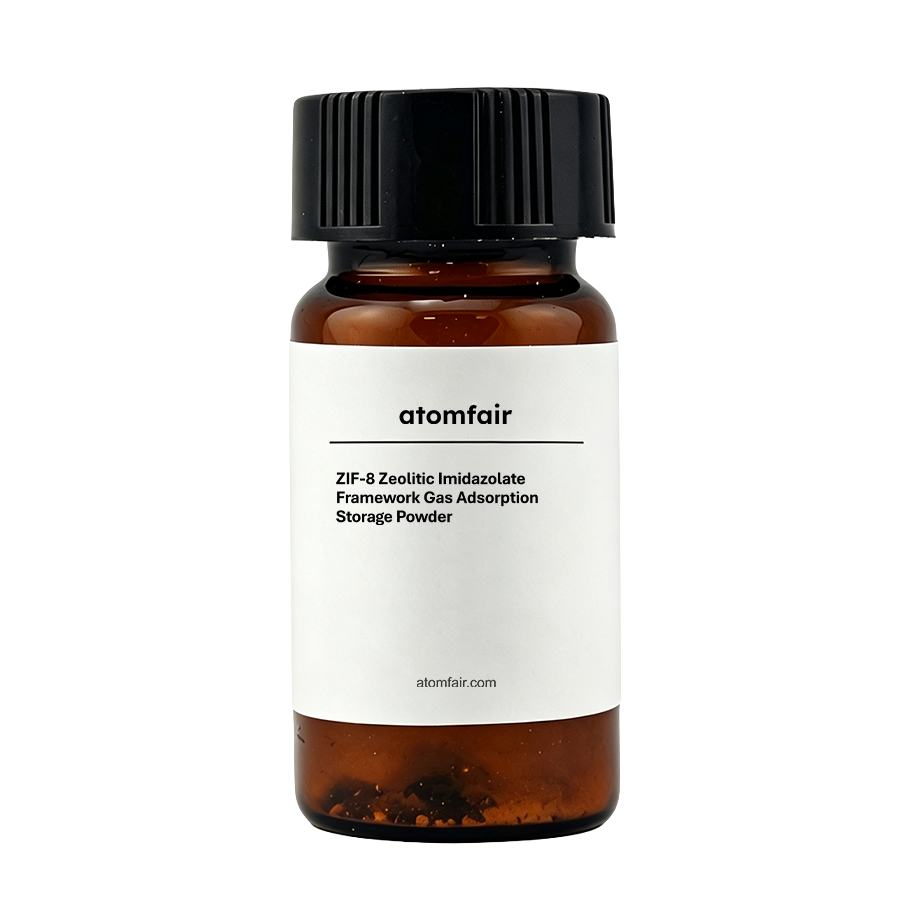
ZIF-8 Zeolitic Imidazolate Framework PowderRESEARCH GRADE MATERIAL
|
||||||||||||||||||||
|
ZIF-8 is sensitive to ambient moisture and requires storage in sealed, dry containers. Thermal activation under vacuum at 120°C for 12 hours is mandatory before experimental use.
- Storage Conditions: Store the powder in a dry, sealed container at ambient or low temperature to prevent moisture contamination.
- Moisture Sensitivity: Handle the material exclusively within an anhydrous inert gas environment to avoid phase contamination or degradation.
- Activation Requirement: Perform thermal activation under vacuum at 120°C for 12 hours prior to experimental use to ensure optimal performance.
- Acid Sensitivity: Avoid exposure to acidic environments as the framework undergoes structural dissolution under acidic conditions.
- Phase Contamination Prevention: Keep containers tightly sealed when not in use to prevent degradation from ambient exposure.
ZIF-8 must be activated under vacuum at 120°C for 12 hours before use. All handling should occur in an anhydrous inert gas environment to prevent moisture contamination.
Required Equipment: Vacuum oven, Inert gas glovebox
- Inspect container
Inspect the container seal for damage or prior breach before opening. - Transfer powder
Transfer the powder to a suitable vessel inside an anhydrous inert gas environment. - Place in vacuum oven
Place the vessel in a vacuum oven and apply vacuum. - Heat to 120°C
Heat the oven to 120°C and maintain for 12 hours. - Cool under inert gas
After activation, cool the sample to room temperature under inert atmosphere. - Store activated material
Store the activated material in a sealed container under inert gas until use.
What are the specific surface area and pore characteristics of ZIF-8 that make it suitable for gas storage?
ZIF-8 exhibits a BET surface area of 1500 m²/g, a total pore volume of 0.66 cm³/g, and a dual pore size distribution of 0.34 nm and 1.1 nm. These microporous properties provide high-capacity adsorption sites and molecular sieving capabilities, optimizing performance for high-density gas storage and substance retention.
How does ZIF-8 perform in aqueous and alkaline environments compared to acidic conditions?
ZIF-8 maintains structural integrity in water and strongly alkaline solutions without phase degradation, making it suitable for aqueous and high-pH workflows. However, under acidic conditions the framework undergoes controlled dissolution, enabling responsive disassembly for applications such as triggered drug release or metal recovery.
What is the required activation protocol for ZIF-8 powder before experimental use?
To ensure optimal performance, ZIF-8 must be thermally activated under vacuum at 120°C for 12 continuous hours prior to use. The powder is highly sensitive to ambient moisture, so containers must remain tightly sealed or be handled in an anhydrous inert gas environment to prevent contamination before activation.
ZIF-8 powder offers a high BET surface area of 1500 m²/g and dual micropore system (0.34 nm/1.1 nm) for gas storage and molecular adsorption, with thermal stability exceeding 400°C and resistance to aqueous/alkaline environments, but requires strict anhydrous handling and thermal activation prior to use to prevent phase contamination.
Positive
- High specific surface area: BET surface area of 1500 m²/g optimizes boundary surface kinetics and molecule retention capacities for gas storage and adsorption applications.
- Thermal and alkaline stability: Crystalline network maintains integrity in aqueous matrices and highly alkaline solutions, with thermal decomposition thresholds exceeding 400°C, ensuring robust performance under demanding workflows.
Trade-offs
- Requires thermal activation: Optimal framework performance requires initial vacuum activation at 120°C for 12 hours prior to experimental use, adding preparation time and infrastructure demands.
- Sensitive to ambient exposure: Product must be kept in sealed containers or handled under anhydrous inert gas to prevent phase contamination or degradation from moisture, requiring strict environmental control.
Every advanced material, component, equipment, and instrument in our catalog is backed by rigorous testing. We maintain strict internal quality management frameworks and align with CE conformity metrics to deliver transparent, reproducible performance data via our public open-science repository.
To request raw batch performance data, submit formal vendor registration paperwork, or execute a fast-turnaround R&D manufacturing loop, contact us at inquiry@atomfair.com.
Item is dispatched under the Atomfair Shipping & Delivery Framework (Free worldwide shipping on orders over $59 USD excl. heavy equipment). Return is governed by the Atomfair Return & Refund Policy (7-day technical return window).