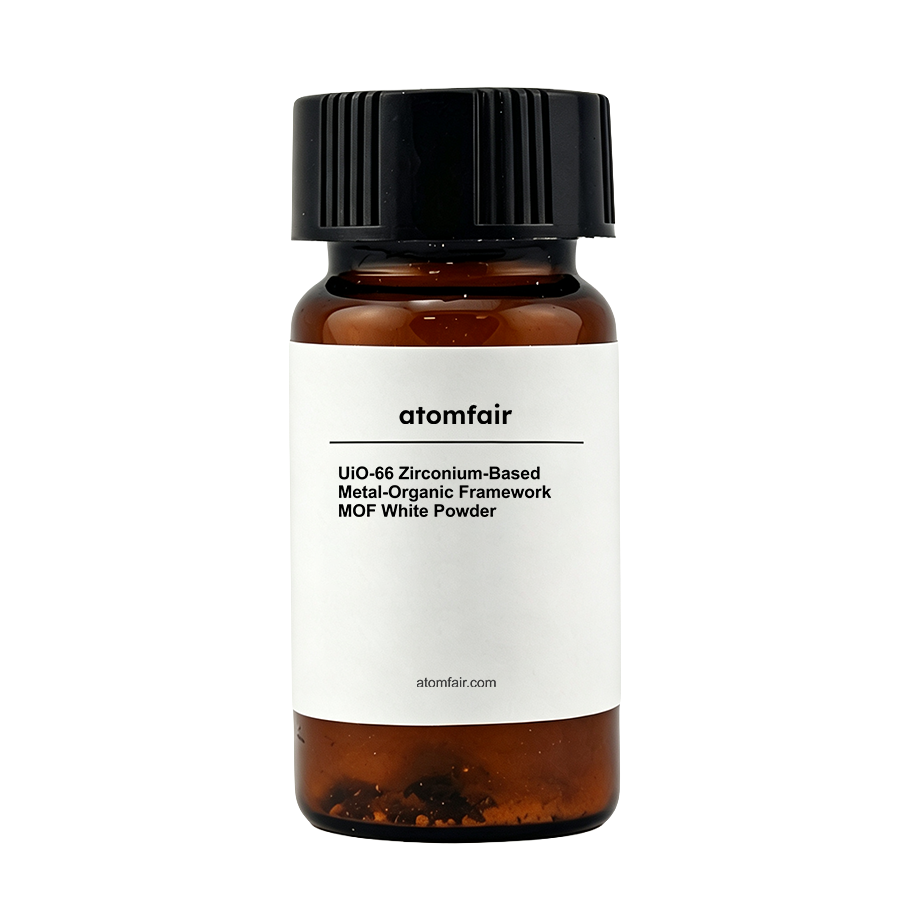
UiO-66 (AF-MO-D-UIO6-1072-0000)RESEARCH GRADE MATERIAL
|
|||||||||||||||||||||||||||||||||||
|
|||||||||||||||||||||||||||||||||||
Activation under vacuum at 120°C for 12 hours is recommended before analytical testing to release full framework porosity. Storage must remain dry and tightly sealed to prevent moisture exposure.
- Pre-Activation: Activate the material under vacuum at 120°C for 12 hours to release full framework porosity before analytical testing.
- Moisture Protection: Maintain the material in a dry, tightly sealed environment to prevent moisture exposure.
- Storage Temperature: Preserve the material under ambient or cryogenic low-temperature ranges.
- Thermal Processing Limit: Maintain processing temperatures at or below 400°C to preserve the crystal lattice.
- Aqueous and Acidic Compatibility: The framework maintains phase stability in multi-phase aqueous solutions and aggressive acidic environments.
Activate the framework under vacuum at 120°C for 12 hours to open its full pore structure before use. Store the activated powder in a dry, tightly sealed container to prevent moisture uptake.
Required Equipment: Vacuum oven
- Load material
Place the UiO-66 powder into a vacuum oven. - Set temperature
Set the oven temperature to 120°C. - Evacuate and hold
Apply vacuum and maintain the activation conditions for 12 hours. - Store activated powder
Transfer the activated powder to a dry, tightly sealed container to prevent moisture exposure.
How does the dual-pore structure of UiO-66 affect its gas adsorption selectivity compared to single-pore MOFs?
UiO-66 features two distinct pore channels at 0.8 nm and 1.1 nm, enabling size-selective molecular sieving and tunable adsorption kinetics. This dual-pore architecture enhances separation efficiency for mixed gas streams by providing multiple diffusion pathways, which is particularly valuable for CO2 capture and hydrocarbon separation.
Can UiO-66 be used in aqueous-phase catalytic reactions without structural degradation?
Yes, UiO-66 exhibits exceptional phase stability in multi-phase aqueous solutions and aggressive acidic environments. The material maintains perfect structural resilience under these conditions, making it a reliable catalyst support or adsorbent for water-based processes.
What is the recommended activation protocol to achieve the full surface area of UiO-66?
To release full framework porosity before analytical testing, activate UiO-66 under vacuum at 120°C for 12 hours. This pre-treatment removes adsorbed moisture, solvents, or guest molecules, ensuring the material reaches its specified BET surface area of 1100 m²/g.
This variable-weight UiO-66 (zirconium MOF) offers a benchmark 1100 m²/g BET surface area with dual-pore architecture (0.8 nm and 1.1 nm), thermal stability >400°C, and exceptional resilience in aqueous and acidic environments, making it a reliable platform for gas adsorption, storage, and catalysis research.
Positive
- High surface area and dual-pore uniformity: With a BET surface area of 1100 m²/g and precisely controlled 0.8 nm and 1.1 nm pore channels, this MOF ensures predictable molecular diffusion and high capacity for gas capture and catalytic substrate applications.
- Exceptional chemical and thermal stability: The coordination framework maintains structural integrity in aqueous solutions, aggressive acidic media, and at temperatures exceeding 400°C, enabling use under demanding processing conditions.
Trade-offs
- Pre-activation required for full porosity: To release the complete framework porosity, the material must be activated under vacuum at 120°C for 12 hours before analytical use, adding a preparation step for lab workflows.
- Strict moisture control during storage: The powder must be stored in a dry, tightly sealed environment to prevent moisture adsorption, which could compromise its pore structure and performance.
Every advanced material, component, equipment, and instrument in our catalog is backed by rigorous testing. We maintain strict internal quality management frameworks and align with CE conformity metrics to deliver transparent, reproducible performance data via our public open-science repository.
To request raw batch performance data, submit formal vendor registration paperwork, or execute a fast-turnaround R&D manufacturing loop, contact us at inquiry@atomfair.com.
Item is dispatched under the Atomfair Shipping & Delivery Framework (Free worldwide shipping on orders over $59 USD excl. heavy equipment). Return is governed by the Atomfair Return & Refund Policy (7-day technical return window).