Description
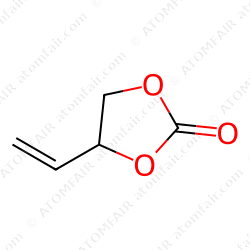
1,3-Dioxolan-2-one, 4-ethenyl- (CAS No. 4427-96-7), also known as Vinylethylene Carbonate, is a high-purity organic compound with the molecular formula C5H6O3. This specialized chemical is widely recognized as a critical electrolyte additive in lithium-ion battery applications. Its IUPAC name, 4-ethenyl-1,3-dioxolan-2-one, reflects its cyclic carbonate structure with a reactive vinyl group, making it ideal for enhancing battery performance. With a purity grade suitable for advanced electrochemical research and industrial battery production, this compound serves as a superior film-forming additive to improve cycle life and stability in lithium secondary batteries. Packaged under inert conditions to ensure stability, it is a must-have for researchers and engineers working on next-generation energy storage solutions.
Properties
- CAS Number: 4427-96-7
- Complexity: 119
- IUPAC Name: 4-vinyl-1,3-dioxolan-2-one
- InChI: InChI=1S/C5H6O3/c1-2-4-3-7-5(6)8-4/h2,4H,1,3H2
- InChI Key: BJWMSGRKJIOCNR-UHFFFAOYSA-N
- Exact Mass: 114.031694049
- Molecular Formula: C5H6O3
- Molecular Weight: 114.10
- SMILES: C=CC1COC(=O)O1
- Topological: 35.5
- Monoisotopic Mass: 114.031694049
- Synonyms: 4427-96-7, Vinylethylene Carbonate, 1,3-Dioxolan-2-one, 4-ethenyl-, DTXSID60883553, DTXCID901023074, 4-Vinyl-1,3-dioxolan-2-one, 4-ethenyl-1,3-dioxolan-2-one, MFCD00143315, SCHEMBL48013, 2-Oxo-4-vinyl-1,3-dioxolane, 4-vinyl-[1,3]dioxolan-2-one, 4-vinyl-1,3-dioxaolane-2-one, 4-Vinyl-1,3-dioxolan-2-one, stabilized with 0.1% hydroquinone, AKOS015891117, 4-Vinyl-1,3-dioxolan-2-one, 99%, CS-W011250, AS-11362, DB-051205, EN300-7374804
Application
1,3-Dioxolan-2-one, 4-ethenyl-, is primarily utilized as a high-reactivity film-forming additive in lithium-ion battery electrolytes. It enhances the solid electrolyte interphase (SEI) layer on anode surfaces, improving battery cycle life and thermal stability. This compound is particularly valuable in high-energy-density applications such as electric vehicles and portable electronics. Its vinyl group enables efficient polymerization during battery operation, contributing to a more robust SEI. Researchers also explore its potential in advanced electrolyte formulations for next-generation lithium-metal batteries.
Safety and Hazards
GHS Hazard Statements
- H301 (80.3%): Toxic if swallowed [Danger Acute toxicity, oral]
- H317 (15.2%): May cause an allergic skin reaction [Warning Sensitization, Skin]
- H373 (16.7%): May causes damage to organs through prolonged or repeated exposure [Warning Specific target organ toxicity, repeated exposure]
Precautionary Statements
- P260, P261, P264, P270, P272, P280, P301+P316, P302+P352, P319, P321, P330, P333+P317, P362+P364, P405, and P501
Hazard Classes and Categories
- Acute Tox. 3 (80.3%)
- Skin Sens. 1B (15.2%)
- STOT RE 2 (16.7%)
If you are interested or have any questions, please contact us at support@atomfair.com
Disclaimer: Sold exclusively for laboratory research. Prohibited for commercial use, diagnostics, or human/animal applications. Buyers assume all compliance liability.


Reviews
There are no reviews yet.