Description
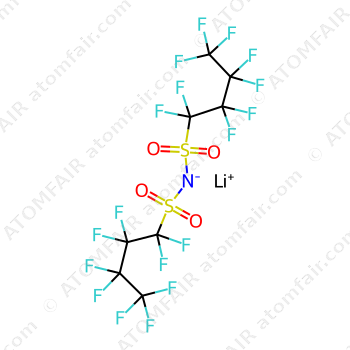
Lithium Bis(1,1,2,2,3,3,4,4,4-nonafluoro-1-butanesulfonyl)imide (CAS No. 119229-99-1) is a highly specialized lithium salt with the molecular formula C8F18LiNO4S2. This compound is characterized by its unique perfluorinated sulfonylimide structure, offering exceptional thermal stability, electrochemical robustness, and hydrophobicity. It is widely utilized as a conductive salt in advanced electrolyte formulations for lithium-ion batteries, particularly in high-voltage and high-temperature applications. The presence of nonafluorobutyl groups enhances its solubility in organic solvents while maintaining low viscosity, making it ideal for precision electrochemical systems. This product is synthesized under stringent quality control to ensure high purity (>98%) and minimal trace impurities, catering to the demands of research and industrial applications.
Properties
- CAS Number: 119229-99-1
- Complexity: 876
- IUPAC Name: lithium;bis(1,1,2,2,3,3,4,4,4-nonafluorobutylsulfonyl)azanide
- InChI: InChI=1S/C8F18NO4S2.Li/c9-1(10,5(17,18)19)3(13,14)7(23,24)32(28,29)27-33(30,31)8(25,26)4(15,16)2(11,12)6(20,21)22;/q-1;+1
- InChI Key: QIWLMMWTZVIAFK-UHFFFAOYSA-N
- Exact Mass: 586.9141352
- Molecular Formula: C8F18LiNO4S2
- Molecular Weight: 587.2
- SMILES: [Li+].C(C(C(F)(F)S(=O)(=O)[N-]S(=O)(=O)C(C(C(C(F)(F)F)(F)F)(F)F)(F)F)(F)F)(C(F)(F)F)(F)F
- Topological: 86
- Monoisotopic Mass: 586.9141352
- Synonyms: LITHIUM BIS(1,1,2,2,3,3,4,4,4-NONAFLUORO-1-BUTANESULFONYL)IMIDE, 692-764-2, 119229-99-1, Lithium Bis(nonafluorobutanesulfonyl)imide, lithium;bis(1,1,2,2,3,3,4,4,4-nonafluorobutylsulfonyl)azanide, LITHIUMBIS(1,1,2,2,3,3,4,4,4-NONAFLUORO-1-BUTANESULFONYL)IMIDE, N,N-bis(1,1,2,2,3,3,4,4,4-nonafluorobutyl)sulfonylamine lithium salt, MFCD06200837, DTXSID70893345, BS-26094, L0307, NS00111367, Bis(nonafluorobutanesulfonyl)imide Lithium Salt, D91264
Application
Lithium Bis(1,1,2,2,3,3,4,4,4-nonafluoro-1-butanesulfonyl)imide is primarily employed as a lithium-ion battery electrolyte additive, where it improves ionic conductivity and electrode stability. Its perfluorinated structure makes it suitable for high-voltage battery systems, such as those used in electric vehicles and energy storage. Researchers also explore its use in electrochemical sensors and capacitors due to its low moisture sensitivity and wide electrochemical window. Additionally, it serves as a model compound for studying anion effects in lithium salt chemistry.
Safety and Hazards
GHS Hazard Statements
- H314 (100%): Causes severe skin burns and eye damage [Danger Skin corrosion/irritation]
- H318 (50%): Causes serious eye damage [Danger Serious eye damage/eye irritation]
Precautionary Statements
- P260, P264, P264+P265, P280, P301+P330+P331, P302+P361+P354, P304+P340, P305+P354+P338, P316, P317, P321, P363, P405, and P501
Hazard Classes and Categories
- Skin Corr. 1B (100%)
- Eye Dam. 1 (50%)
If you are interested or have any questions, please contact us at support@atomfair.com
Disclaimer: Sold exclusively for laboratory research. Prohibited for commercial use, diagnostics, or human/animal applications. Buyers assume all compliance liability.


Reviews
There are no reviews yet.