Description
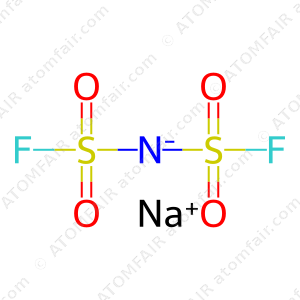
Sodium Bis(fluorosulfonyl)imide (NaFSI) is a high-purity, advanced electrolyte salt widely utilized in the development of next-generation energy storage systems. With the molecular formula F2NNaO4S2 and CAS number 100669-96-3, this compound exhibits exceptional thermal stability, high ionic conductivity, and superior electrochemical performance, making it ideal for lithium-ion and sodium-ion battery applications. Its low viscosity and excellent solubility in organic solvents enhance battery efficiency and cycle life. NaFSI is synthesized under stringent quality controls to ensure ≥99.9% purity, meeting the rigorous demands of research institutions and industrial-scale production. Available in various packaging options, it is a critical component for researchers exploring high-voltage electrolytes, solid-state batteries, and other cutting-edge electrochemical technologies.
Properties
- CAS Number: 100669-96-3
- Complexity: 235
- IUPAC Name: sodium;bis(fluorosulfonyl)azanide
- InChI: InChI=1S/F2NO4S2.Na/c1-8(4,5)3-9(2,6)7;/q-1;+1
- InChI Key: VCCATSJUUVERFU-UHFFFAOYSA-N
- Exact Mass: 202.91345043
- Molecular Formula: F2NNaO4S2
- Molecular Weight: 203.13
- SMILES: [N-](S(=O)(=O)F)S(=O)(=O)F.[Na+]
- Topological: 86
- Monoisotopic Mass: 202.91345043
- Synonyms: sodium bis(fluorosulfonyl)imide, 100669-96-3, 834-502-3, sodium;bis(fluorosulfonyl)azanide, [bis(fluorosulfonyl)amino]sodium, Na[N(SO2F)2], sodium bis(fluorosulfonyl)azanide, NaFSI, sodiumbis(fluorosulfonyl)imide, SCHEMBL769482, VCCATSJUUVERFU-UHFFFAOYSA-N, MFCD29905041, AKOS040767796, SB66541, Sodium(I) bis(fluorosulfonyl)imide 99.9%, S0992, T71522
Sodium Bis(fluorosulfonyl)imide (NaFSI) serves as a key electrolyte additive in high-performance lithium-ion and sodium-ion batteries, improving conductivity and thermal resilience. It is particularly valuable in solid-state battery research due to its compatibility with polymer and ceramic electrolytes. NaFSI also finds use in supercapacitors and fuel cell applications where stable ion transport is essential. Its low environmental impact compared to traditional salts like LiPF6 makes it a sustainable choice for green energy solutions.
Safety and Hazards
GHS Hazard Statements
- H301 (33.3%): Toxic if swallowed [Danger Acute toxicity, oral]
- H302 (33.3%): Harmful if swallowed [Warning Acute toxicity, oral]
- H314 (66.7%): Causes severe skin burns and eye damage [Danger Skin corrosion/irritation]
- H318 (66.7%): Causes serious eye damage [Danger Serious eye damage/eye irritation]
- H335 (33.3%): May cause respiratory irritation [Warning Specific target organ toxicity, single exposure; Respiratory tract irritation]
Precautionary Statements
- P260, P261, P264, P264+P265, P270, P271, P280, P301+P316, P301+P317, P301+P330+P331, P302+P361+P354, P304+P340, P305+P354+P338, P316, P317, P319, P321, P330, P363, P403+P233, P405, and P501
Hazard Classes and Categories
- Acute Tox. 3 (33.3%)
- Acute Tox. 4 (33.3%)
- Skin Corr. 1B (66.7%)
- Eye Dam. 1 (66.7%)
- STOT SE 3 (33.3%)
If you are interested or have any questions, please contact us at support@atomfair.com
Disclaimer: Sold exclusively for laboratory research. Prohibited for commercial use, diagnostics, or human/animal applications. Buyers assume all compliance liability.
Reviews
There are no reviews yet.